
Clown, Thief, Coach?
"Ultimately, every coach is a thief."

Ultimately, every coach is a thief. I didn't invent football, and neither did Guardiola. He looked at what Cruyff did."
- Thorsten Fink
The idealised image of Belgium, a quaint and developed Benelux nation that embodies and hosts the best of the EU, can at times run aground amidst an atmosphere of organised crime that has led some to warn that the nation risks sliding into “narco-state” territory.
Belgian ports alongside their Dutch brothers to the north make up the primary loading site for the vast majority of the continent’s cocaine and everything else illicit.
To be a criminal or a thief, one needs to be good; this task was much easier in eras before CCTV, where one’s digital footprint wasn’t as easily accessible. Now, there are means to bypass, but most fail; PGPfone, EncroChat, and Telegram have all been proven to have a single point of failure.
In Genk, one of Belgium’s smaller urban centres, it was the modern incarnation of Italy’s infamous Ndrangheta that bore the brunt of poor criminal etiquette, with swathes of their membership base caught in coordinated Europol raids in 2023 and 2024 alongside several other OCGs.
If 2024 signalled the end, or at least the relative breakdown in power of the cities’ mafioso, then 2025 may mark the end for the cities’ footballing head honcho; a man who sits atop an institution well versed in trading foreign commodities in the millions and not averse to stealing and borrowing, as made clear by the quote that opened this piece.
He, like much of the nation’s illicit product, heads to Scotland for what looks like his haly-mary boom-or-bust deal, relying on a late Glasgow night to reinvigorate his prospects and quell discontent back home.
Introducing Coach and Club
Thorsten Fink: (mostly) In His Own Words
"I see myself as a holistic coach, that means I want to develop my players not only athletically, but also personally. That's why empathy and humanity are paramount for a coach. There are studies that show that people don't leave a company because of their job, but because of their colleagues or managers. It's the same in football. A successful team can only emerge when the human element is strong, when there is absolute trust. My motivation is to help the players progress, to develop them, and to see the positive steps they take within a few weeks or months. That's what drives me as a coach.”
"One look at his record says it all: Fink is a winner. Both as a player and later as a coach, he has grabbed prizes. He also always links those results to positive football and he dares to integrate young people. It is no secret that at KRC Genk the development of young talents is an important cornerstone of our operation. It makes Thorsten the right person to lead our young group next season,"
“This is a crucial point. As a coach, you can have as many tactical ideas as you want – if you don't understand what makes your players tick, you won't achieve them. Football is global today, and teams are often multicultural. I see it as my job to create an environment in which every player feels comfortable.”
“A coach needs time to form a team and build structures. That's why I now pay attention to three things before choosing a club: Does the club have a clear vision? Is the youth team systematically integrated? Does the management have the patience to enable sustainable processes?”
“Trust is built through clarity, consistency, and the right mindset. Players need to know that the plan is working—and that happens through training, analysis, and experiences of success. When a team realizes that we can always come back even after falling behind, this trust grows.”
“A very important learning experience in my coaching career was the realization that a coach has to be flexible and adaptable. I didn't invent football, but I learn something new from every coach, regardless of the league.”
“In some leagues, only short-term success counts. That's no longer the right path for me. I look for clubs that want to develop something, with players eager to develop and a long-term, consistent idea.”
“A coach should be measured by how they develop a team – not by who they recently coached or what current successes they can boast.”
Of course, there are players you have to motivate, but I don't see myself as a clown or an entertainer. Motivation must be intrinsic.”
"And Thorsten Fink delegates; he oversees everything with a 'helicopter view, he's like a drone; nothing escapes him,"
Continuity and Summer Spending
Yet again, we’ve managed to luck into facing a side in the midst of chaos.
However, whatever state Genk are in, it’s unlikely to be quite as toxic as ours. Genk have started this season with mismatched socks and shoes on the wrong feet, and much like Martin, Fink likely faces judgement day in the coming weeks, with commentators around Belgium whispering an ultimatum: Rangers on Thursday and Sunday’s derby against STVV, or seek new employment.
Before we jump too far ahead, it’s valuable to examine potential catalysts for such a breakdown in form, particularly in light of what was a relatively strong season last year, namely, player departures.
Genk parted ways with six players of note this summer. Much like Brugge previously, Genk are famed for their ability to coexist with the churn and profits that define their operating model, so the fact that their two most valuable players left is not the sort of torpedo to one’s chances it might be at other clubs. In total, they saw three starters leave, as well as three peripheral first-team members, two of whom were on loan last season and have been written off for some time now.
Tolu Arokodare to Wolves (€26m)
Christopher Bonsu Baah to Al-Qadsiah (€17m)
Andy Zeqiri to Widzew Lodz (€2m)
Thomas Claes to Zulte Waregem (€0.3m)
Aziz Outtara to Maccabi Netanya (€0.2m)
Mike Penders to Chelsea (End of Loan)
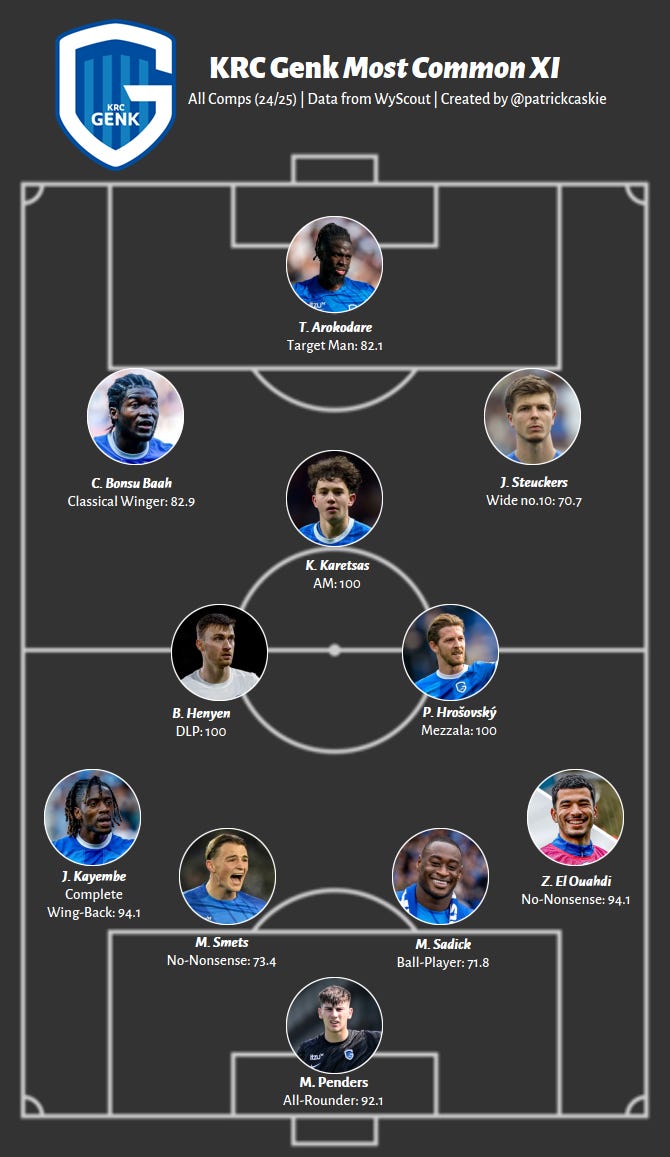
As visualised below, in the simplest terms, they lost their starting no.9, left winger, and goalkeeper, all of whom were standout performers.
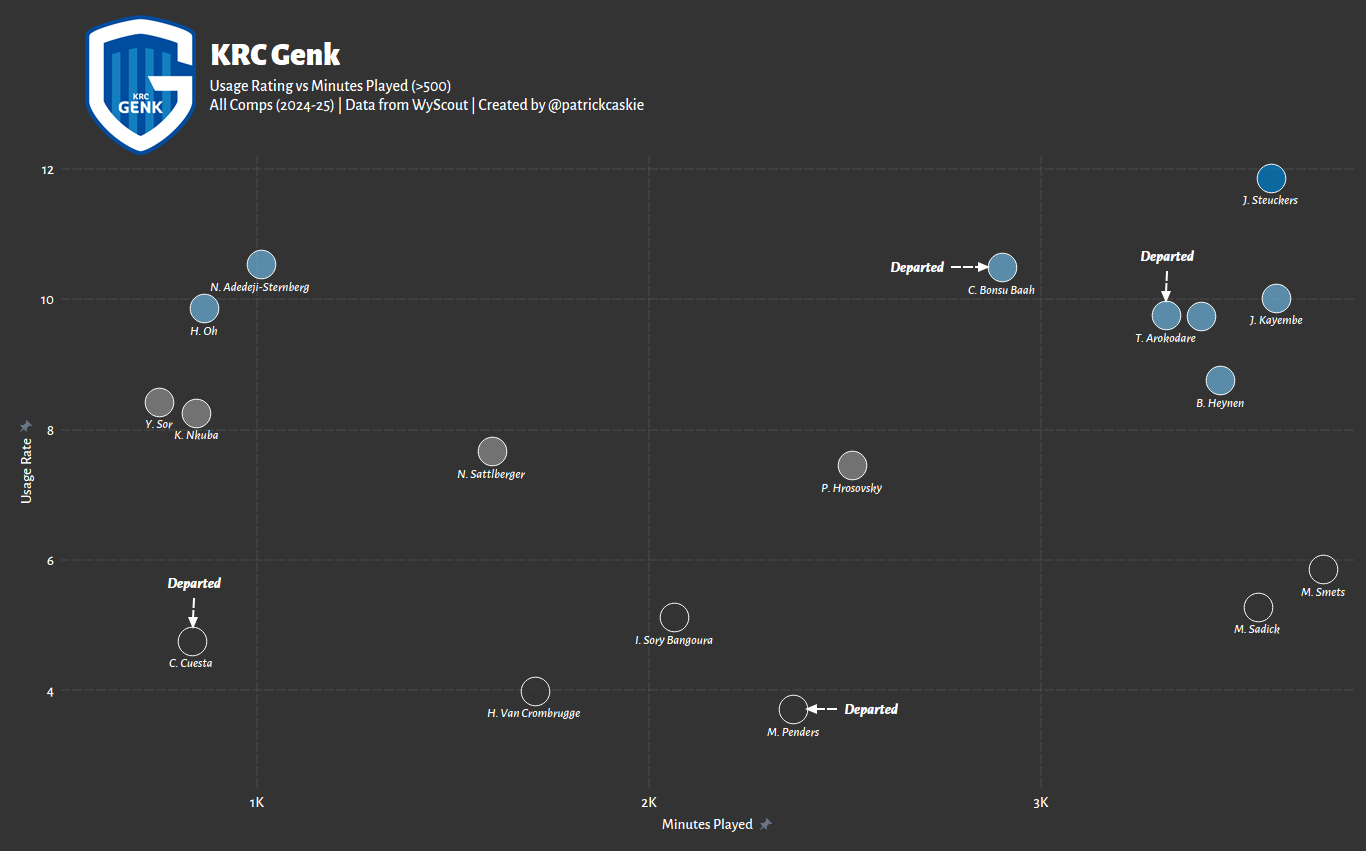
We can come close to accurately capturing the size and shape of the shadows in the squad with the graphic below, which plots minutes played and usage rating. In terms of time spent on the pitch, Genk lost 19.84% of total minutes from the 24/25 season and a usage rating of nearly 28.68%. Both of these are high on their own, but are relatively normal for Genk and represent drastically smaller shares than what our previous opponents, Club Brugge, were dealt this summer. The point to be made is less that they’ve lost tons of players but that they’ve lost a couple of players who likely defined or turbocharged their style of play and relative success last season.
Few players occupied that role more across the country than the league’s top scorer, Tolu Arokodare. As evidenced below, Tolu was as classic and practical as target men come, with lots of penalty box touches and goals, while offering a consistent out-ball, often receiving balls long and high, then controlling and rolling the ball back to a set of dynamic wide forwards.
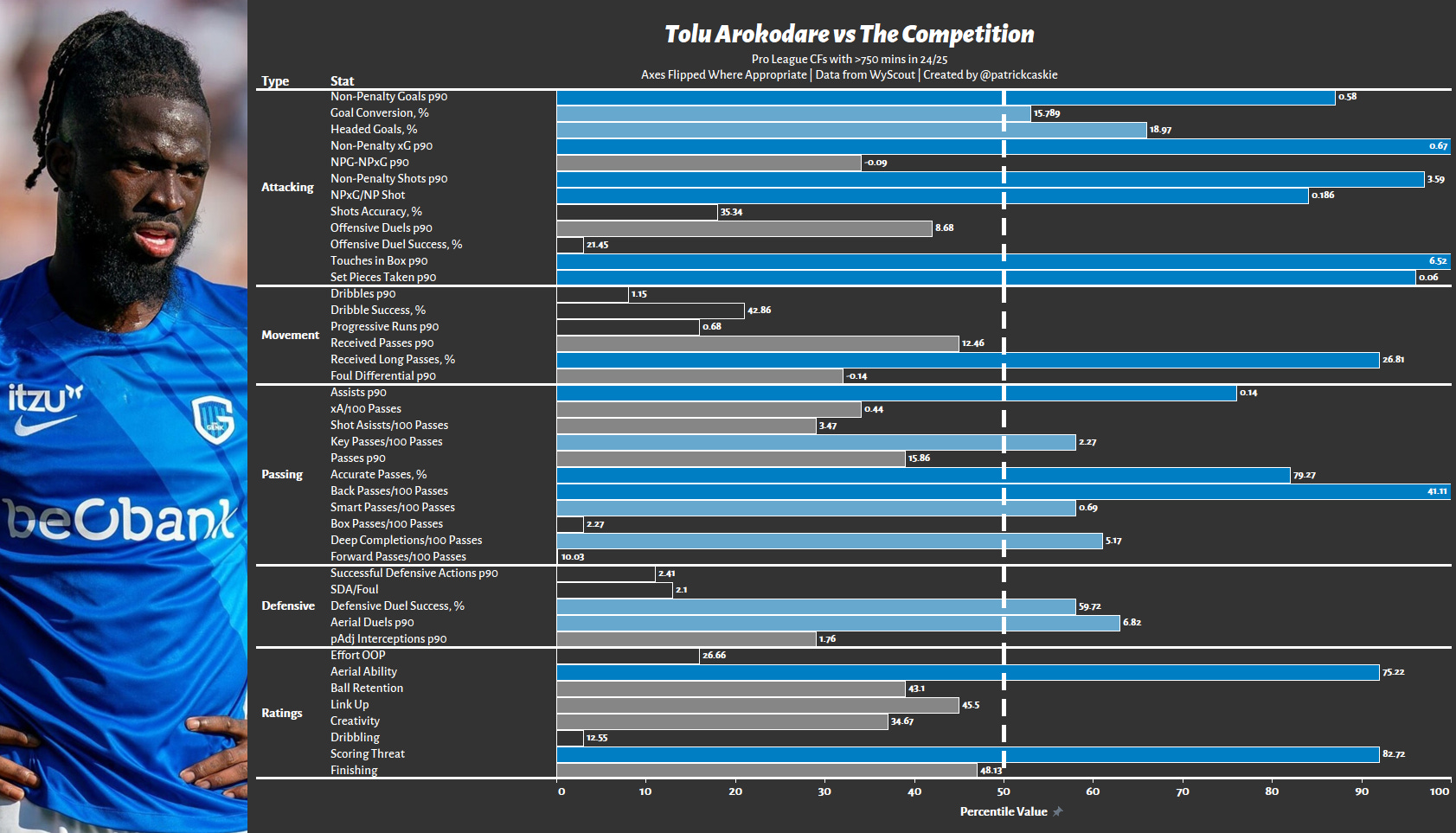
Genk remained relatively well-stocked, especially after the summer shopping spree, as we will explore later. Yet, regardless of the talent in situ, losing a player who, by themselves, accounted for 30 goal contributions is a challenging task. Fink made his love for the Nigerian as clear as day; the quotes below paint the picture.
“Tolu was ridiculed by many before the season. I was laughed at when I said he would be the season's top scorer. For me, he has everything he needs to compete at the highest level.”
“Tolu is a top striker. He is fast, strong in the air, left and right-footed, and he scores. What more could you, as a coach, want? Moreover, he now carries out his defensive tasks more than before.”
“Believe me, no better striker is walking around in Belgium than Tolu. But he must show himself, show passion. Like he did against Club Brugge”
Despite all of Fink’s admiration and his golden boot crown, was Tolu even that much of a standout compared to his previous Genk 9s?
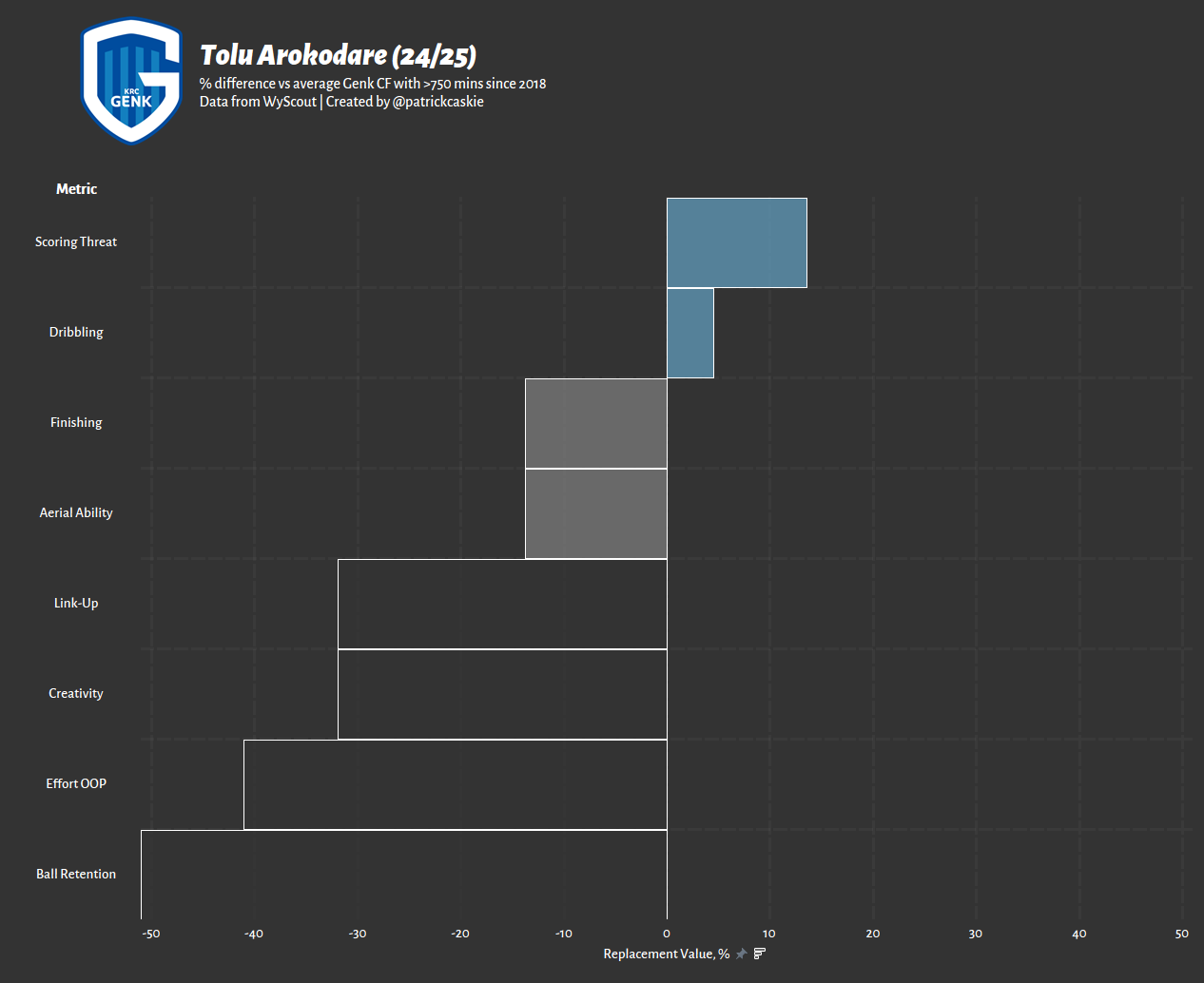
Not really is the answer, Genk and strikers have been a match made in heaven in recent years. Tolu failed to impress as much as his fellow countryman, Paul Onuachu, or Ally Sammata, the Tanzanian, who once played for Aston Villa and Fenerbahce CF; hopefully, he fares better outside of Belgium than those two.
You’re a brave club paying many millions for a Genk ST, going off recent history. For a thorough exploration of Tolu Arkokodare, I recommend the following.

The other headline sale this summer was 20-year-old winger Christopher Bonsu Baah to Saudi Arabian club Al-Qadsiah. Genk tripled their admittedly lofty initial investment of €5.20m two years ago, for a player who, at the time, had played 900 minutes in Norway, making Chermiti look like a seasoned veteran.
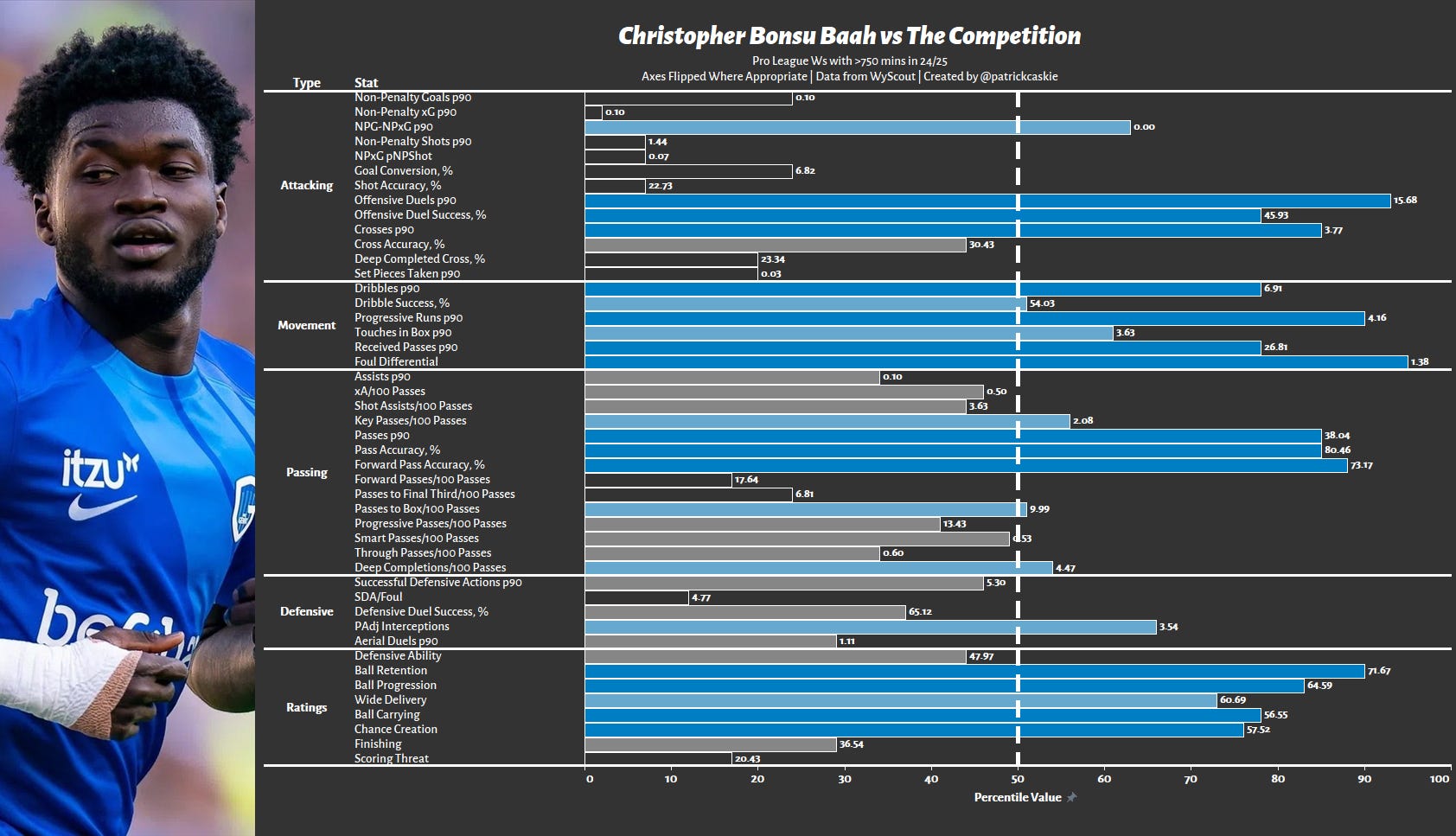
The Ghanaian was an exciting player, an excellent ball carrier, a tricky dribbler, and a good teammate, but had yet to put it all together in the final third. If he had, his move to Saudi Arabia would have been in the eye-watering category as opposed to the somewhat mundane. Like with Tolu, Genk have a variety of riches ready to step up in Bonsu Baah’s absence.
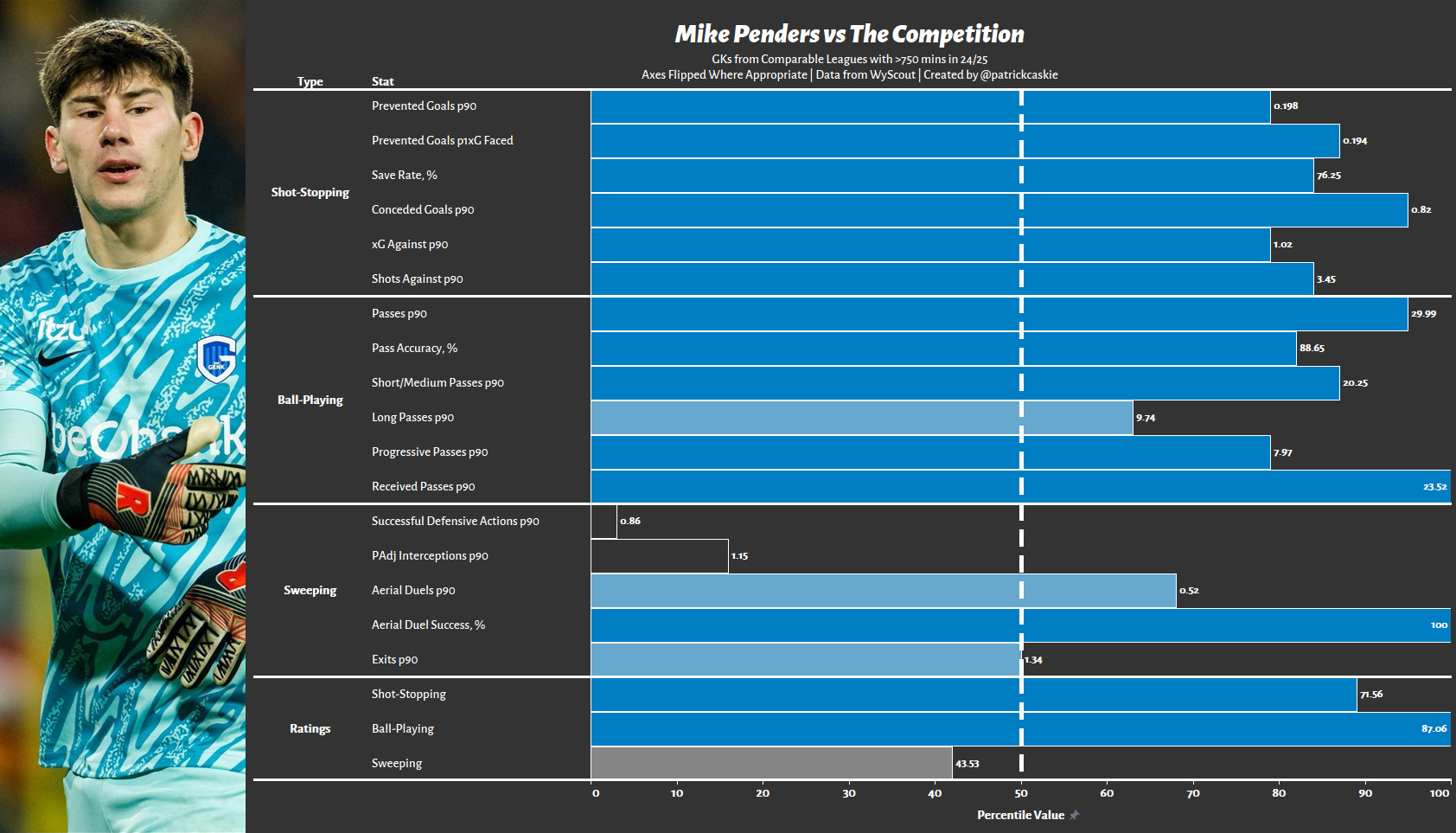
Penders another footsoldier in Blue Co. purgatory joined Chelsea last summer for around €20m, but remained at Genk on loan for the following season. Genk profited massively from the extra season, where the young Belgian was nothing but excellent, as evidenced by the percentile performance graphic above. And what is becoming a theme, they have seemingly replaced him with a more than capable young replacement.
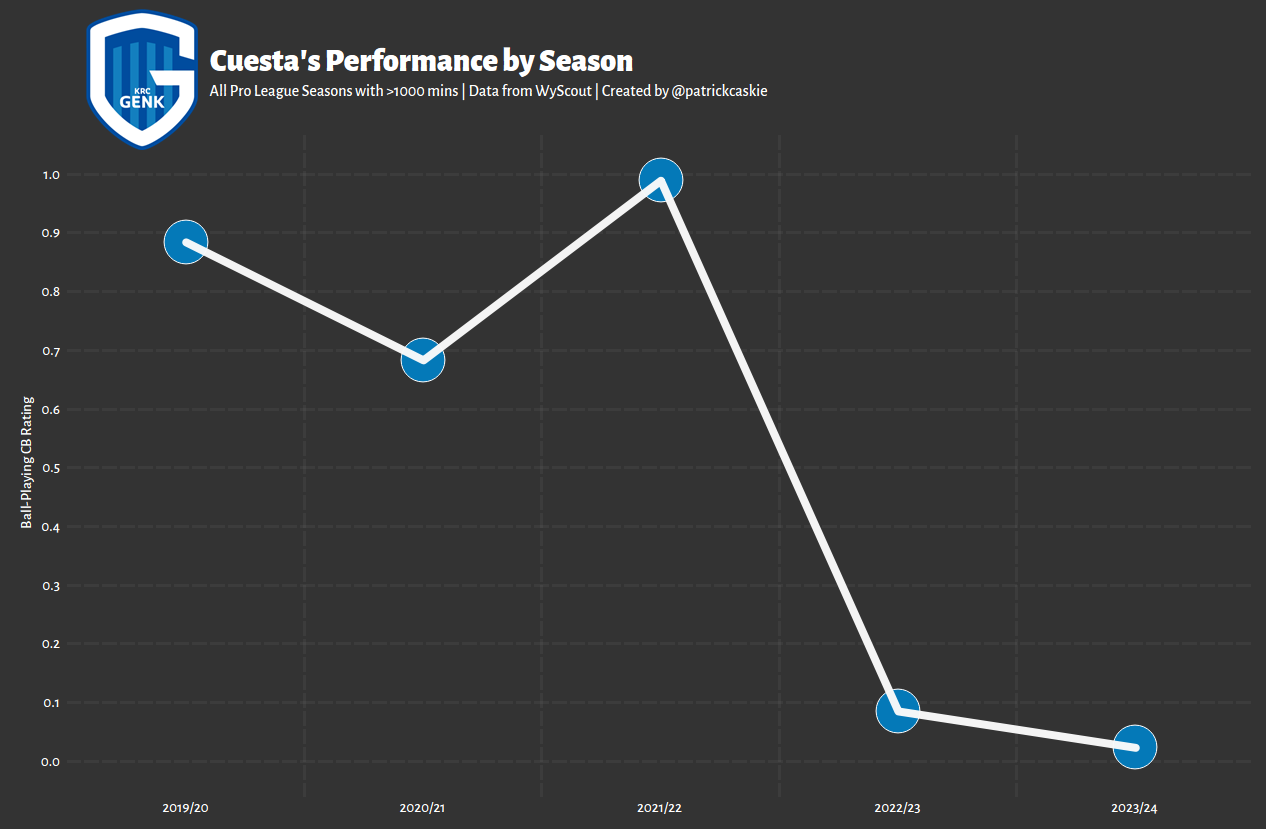
The final sizeable departure was Carlos Cuesta, whose move away from Belgium came at the dying embers of the January window. Cuesta, a long-term fixture in the Genk XI, who was at times excellent and other times not so much, if you give any credence to the graphic above, signed for Galatasaray. Despite the move to RAMS Park, he’s already out on loan, suiting up for Vasco De Gama in the Brazilian Serie A. Given that it’s been nearly 10 months since his departure, there really shouldn’t be much of a hangover or an uncertain reshuffling that may still be in motion in other areas like CF or GK.
Pro League Pedigree
The box-and-whisker plot below compares Club ELO ratings for the Belgian Pro League and Scottish Premiership, providing a rough benchmark for league and club strength.
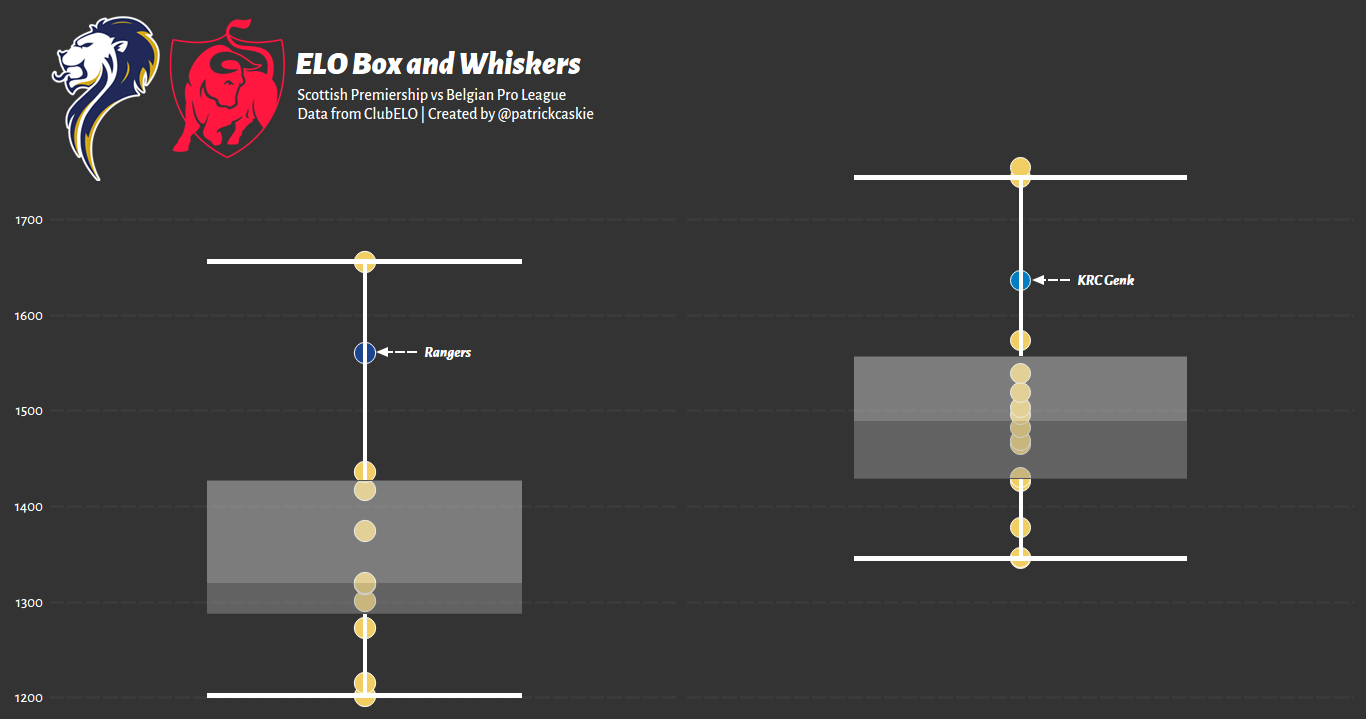
Genk (1622) sit in a comfortable third amongst league peers and appear closer in level to the current Celtic side than Rangers, whose score (1560) places them between Belgium’s fourth and fifth best; Anderlecht and Antwerp. You likely don’t need the graphic above to tell you that the Pro League is a stronger league than ours in basically every metric, besides our ability to get bums in seats.
If we wish to add a second piece of evidence, we can consult UEFA coefficients to help refine our estimation of the Pro League’s quality. The Pro League is the 8th-ranked league, and a closer match to those above them (Netherlands and Portugal) than those below (Turkiye and Czechia). Belgium has collectively scored more than 14 coefficient points in each of the past three seasons, a feat Scotland has never managed.
Genk’s own coefficient is just 11.150, which places them 144th overall, 110 places below Rangers, with a score 45.1 points lower; the distance between them is similar to the club coefficients of USG, Monaco and Fenerbahce. Genk cluster closer to Aberdeen and Hearts than Rangers and Celtic on the European stage. This is obviously a misnomer as they are far stronger than their European exploits would suggest, adding further evidence to the strength and capital spread across the Pro League.
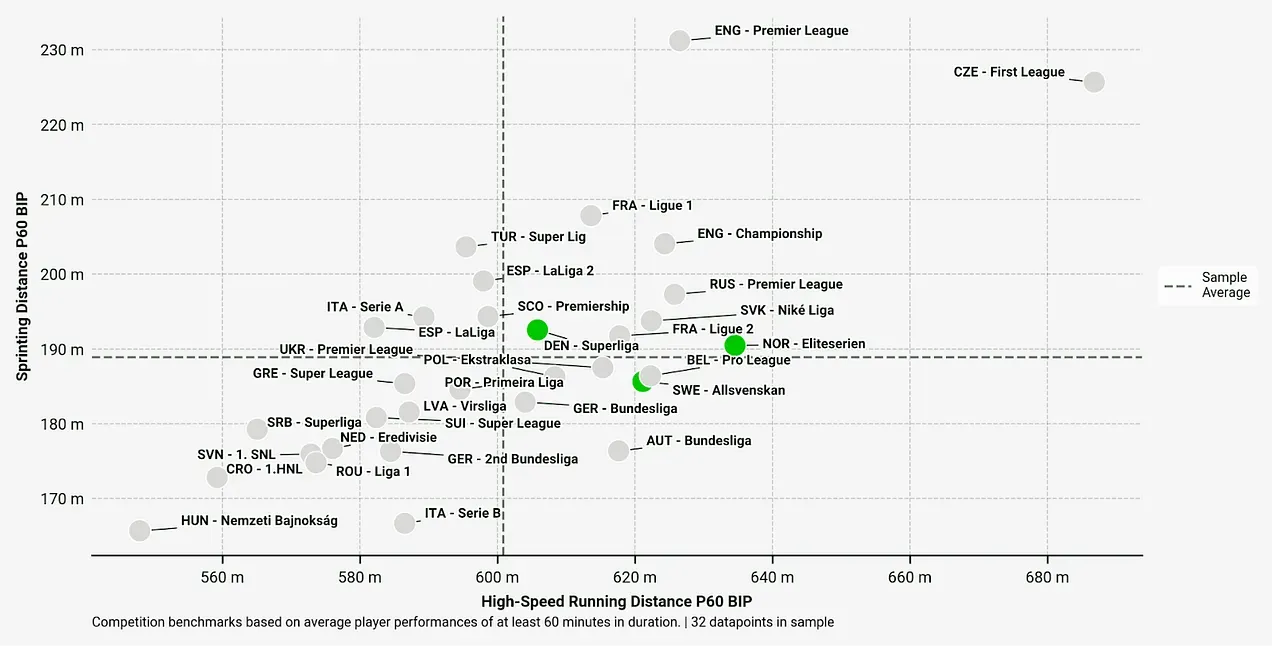
Using the same Scouted Football graphic as in previous pieces, we can see that the Belgian Pro League is not an outlier when it comes to running. In comparison to the Scottish Premiership, games witness more high-speed running in total but a lower share of sprints, suggesting a slightly higher tempo overall, albeit without the same level of breakneck, direct counters characteristic of many Scottish sides.
Deducing Style and Quality Through the Data
Broad Brush Strokes
This section examines performance in broad strokes, identifying patterns across recent seasons. The focus is less on individual results and more on how Genk has functioned over time and what recurring, perhaps structural, patterns we can identify.
Continuing with the ELO theme, below is a list of teams and when we faced them that rank in the same ballpark as this current Genk side. Below that is a list of teams that the ELO system suggests are closest in quality at the time of writing. As cautioned, styles make fights, so this is not an exact proxy for how difficult a side was for us to deal with, but rather their relative quality.
Previous Opponents
S.C. Braga - 14/4/2022
Royal Union Saint-Gilloise - 9/8/22
Celtic - 3/9/23
Sparta Prague - 9/11/23
Viktoria Plzen - 5/8/25
Current ELO Twins
AZ Alkmaar
S.C. Braga
Sevilla
Leicester City
With Plzen, there was reasonable overlap in terms of teams that we both faced during the 24/25 season. With Genk, there is an overlap, but relatively minimal. Although this is entirely unscientific and based on a small sample size, we can take a quick look at how we fared compared to how they fared against the same opponents in the closest match that occurred under the same home/away dynamics, before we begin the serious analysis. Genk fared better in both.
Genk
2-1 (2.70 - 0.89) win hosting USG (15/03/2025)
2-1 (2.18 - 1.77) loss away to Club Brugge (27/07/2025)
Rangers
2-1 (1.76 - 2.40) win hosting USG (30/01/2025)
6-0 (4.27 - 0.12) loss away to Club Brugge (27/08/2025)
And now for the real stuff.
Below, we have all of Brugge’s previous ten league seasons. This helps paint a clear picture of where this current side stands relative to earlier iterations, with the moving average helping reduce some of the noise. The 24/25 season appeared to be a relatively normal campaign, with a customary short peak, although nowhere near as high as those achieved in standout seasons like 18/19 and 20/21. They hovered in the space 0.5 and 0.75xGD, which appears to be their “resting heart rate”. Unlike previous seasons, there was no European campaign, which can at times affect the difference in strength of schedule and muddy the validity of the trend comparison. What is perhaps most important to note is that Genk, at the time of writing, is in the negative for just the fourth time. As previewed earlier, they’re not in a great spot right now, with discourse on Fink similar, albeit not as heated as Martin.
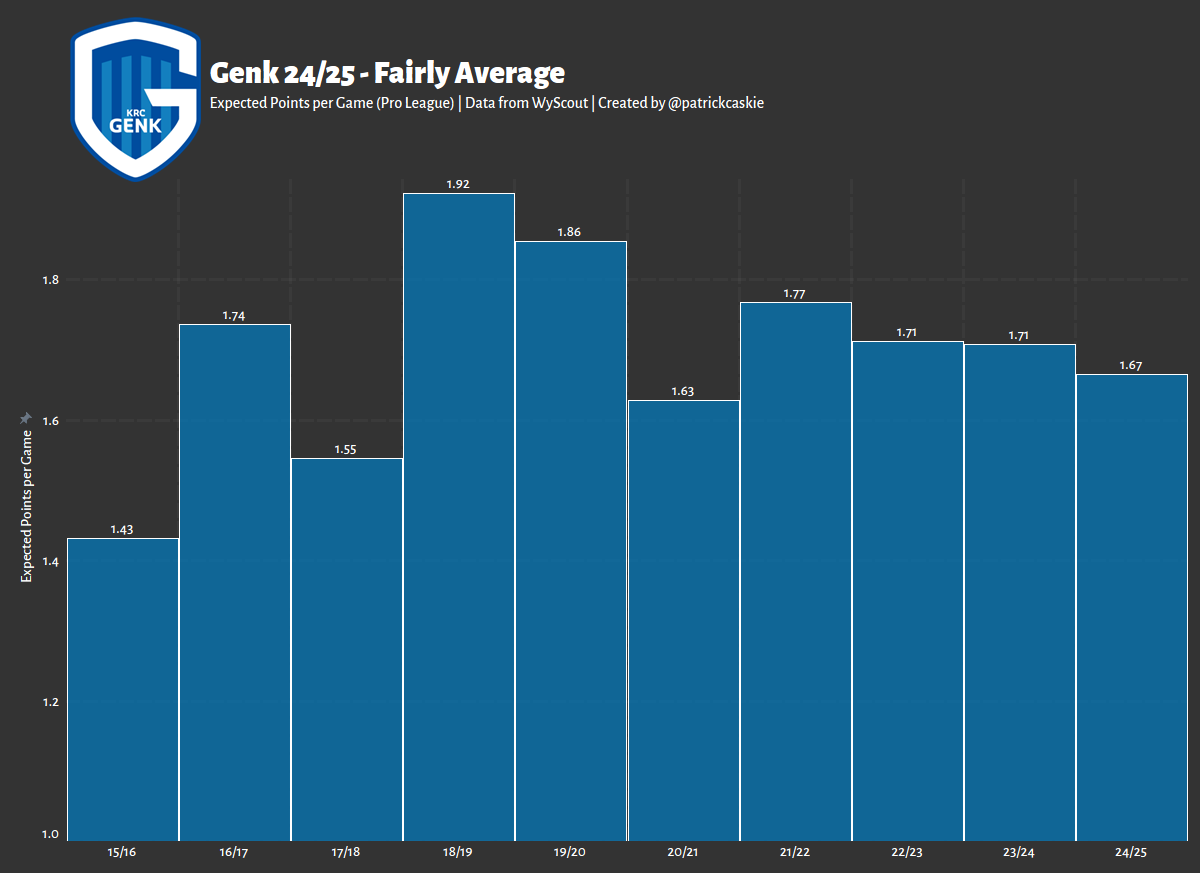
Genk have won the Belgian Pro League on three separate occasions, with the most recent title-win, and the only one covered in our sample, the 18/19 season, led by a familiar face, Phillipe Clement. This also happened to be the season with the strongest xPoints p90, unlikely a fluke.
In comparison, the past few seasons at Genk have seen a moderate decline, but in the grand scheme of things, they have been average. No model is perfect, not least WyScout’s xPoints model, but it’s not hallucinating and has some basis, suggesting that the 24/25 Genk side, in sum, was about as average as they come. An obvious caveat to make is the unique nature of the Belgian split, where points are halved at a certain point. In contrast, the xPoints does not integrate this, but instead treats all 40 games as 3-point affairs come the end of the season.
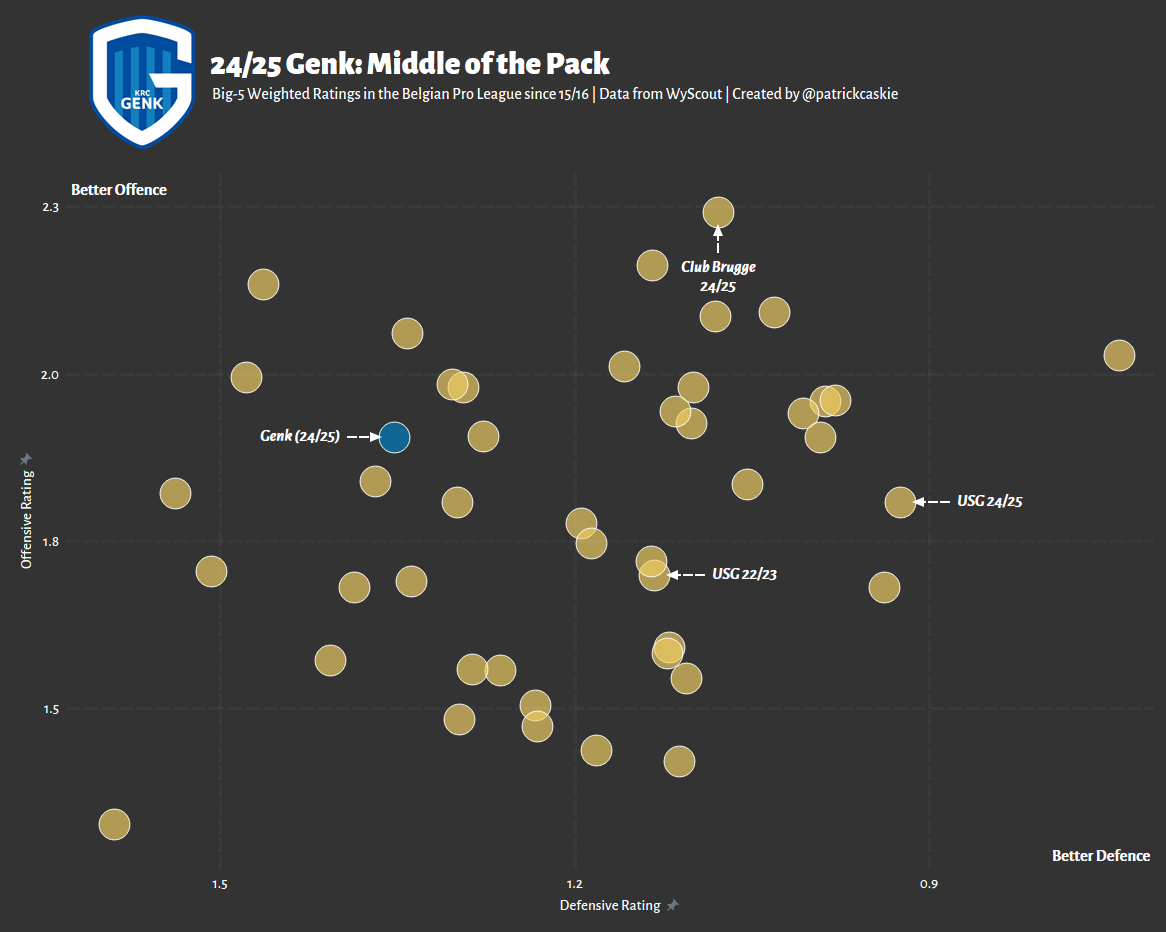
If you're left wanting more general benchmarking or unsure of xPoints, we can look at Genk's weighted ratings. What this shows is that Genk are an above-average offence equally open out of possession. They are considerably weaker than Bruggem was last season's USG and are likely on aggregate closest to the USG side we played in the 2022/23 UCL qualifiers.
Despite what is likely a more fluid and effective attack than the recent USG side we played, I think it's safe to say that this Genk side is not as good as the other two Pro League sides we've faced in 2025, and is undoubtedly a considerable distance off the pace set by Club Brugge.
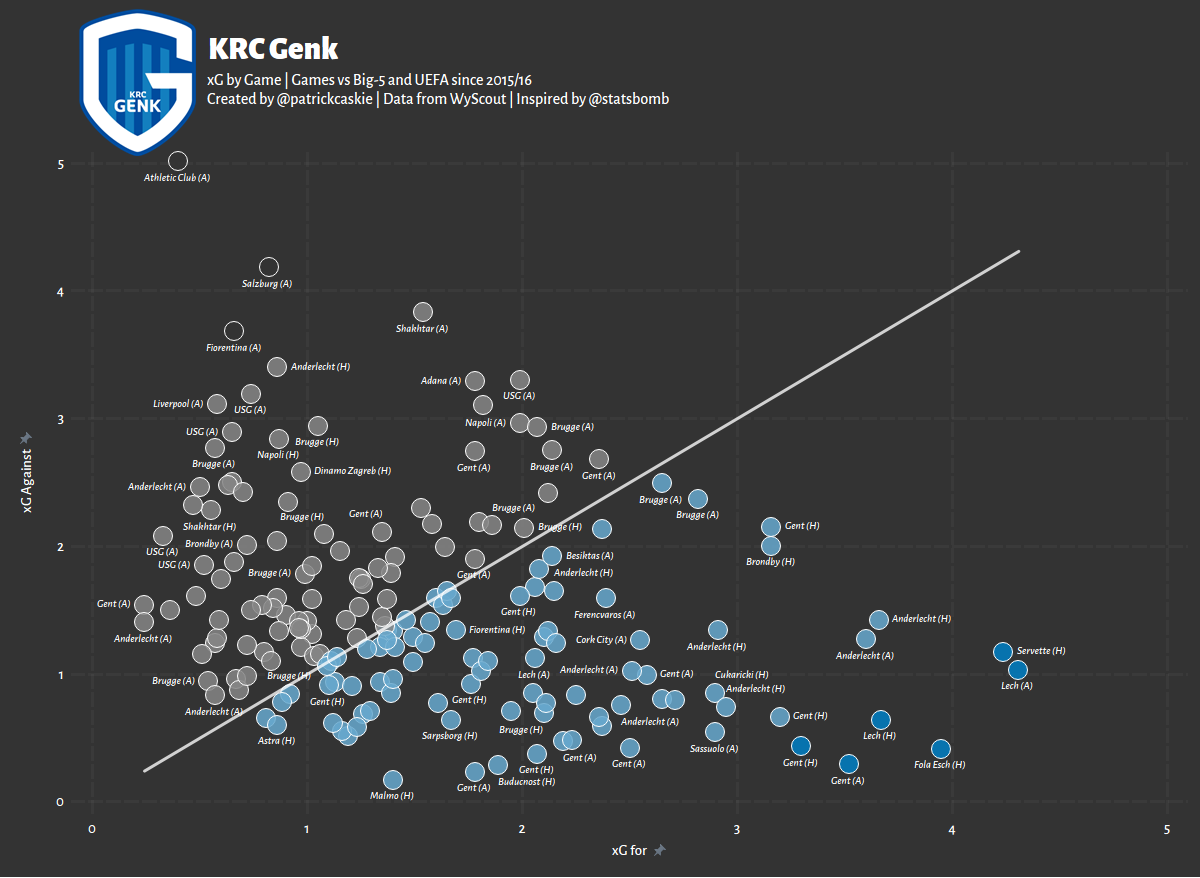
If we pass the season-specific analysis, we can open it up to a targeted analysis that isolates opponents I deem “tough”, which includes Belgium’s new “big-5” (USG, Anderlecht, Genk, and Gent), as well as opponents in UEFA competitions, mainly the Conference League.
Genk are prone to a bit of battering when playing up, but essentially give what they take and take what they give, as evidenced by the distribution below.
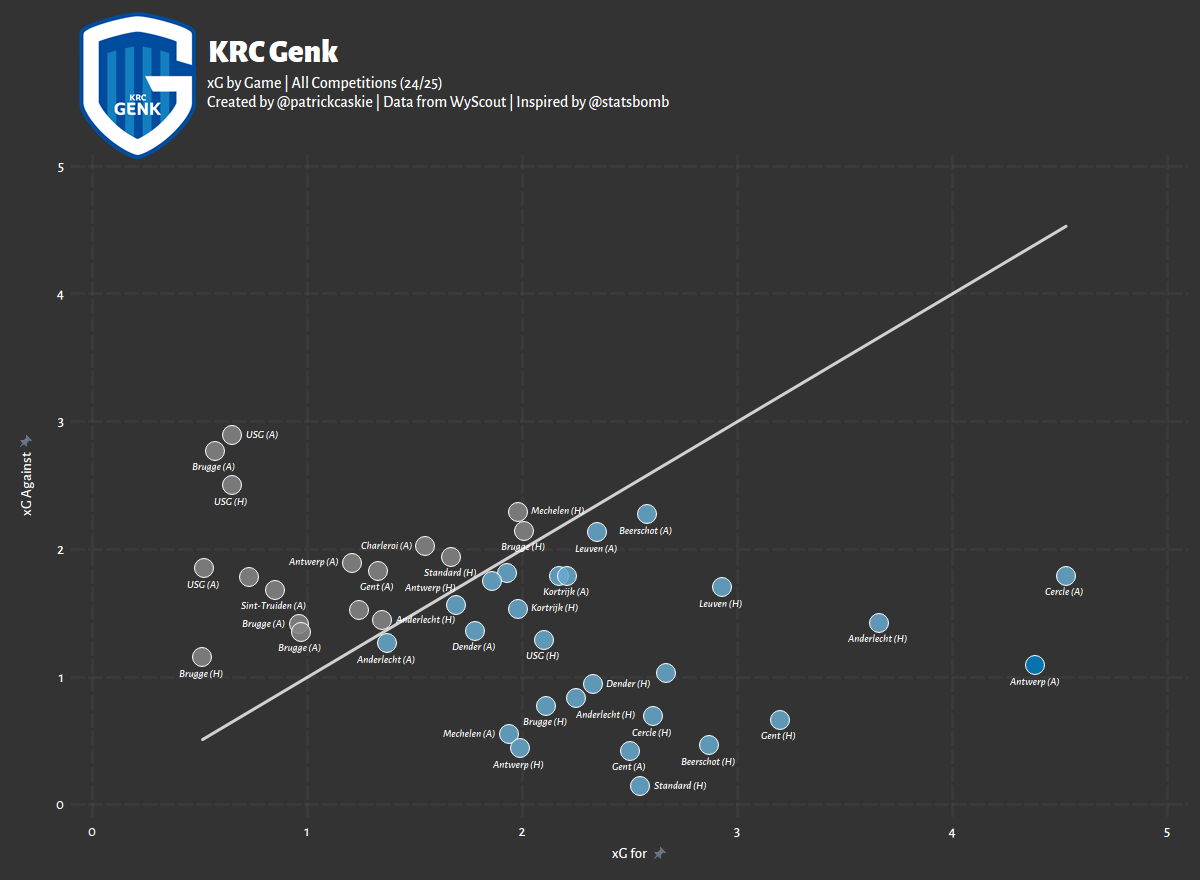
Focusing in, let’s switch the 10-season lens for a single season, the recently completed 24/25 season.
Below we have the xG for and xG against plotted from the 24/25 season—naturally, the distribution strays rightward, indicating that Genk was the stronger side in most games. Genk did an excellent job of essentially eliminating all “batterings” as they kept all opponents to less than 3 xG, but were equally not a side that would regularly take teams apart, evidenced by the relatively sparse distribution of their own games with more than 3 xG.
The most important thing to take away is that across all their games last season, there was not a single one in which both teams scored less than 1xG. Rangers of recent have been so turgid that there is a genuine threat to break this chain, although Genk rarely “do boring”.
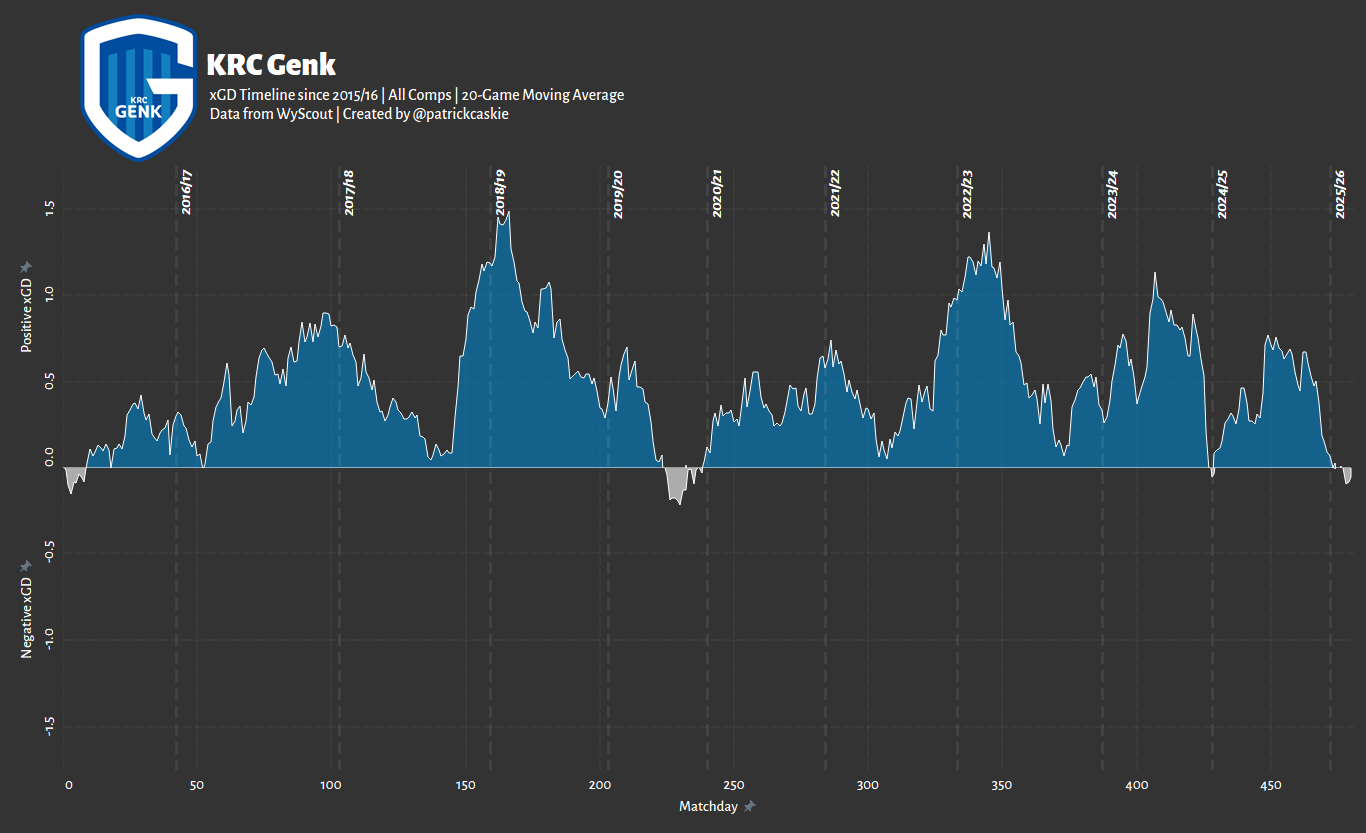
Shifting to the league campaign specifically, we can plot the moving average of their Expected Goal Difference (xGD). This metric provides a clear picture of how the league season unfolded, highlighting when the team's form peaked and when it collapsed.
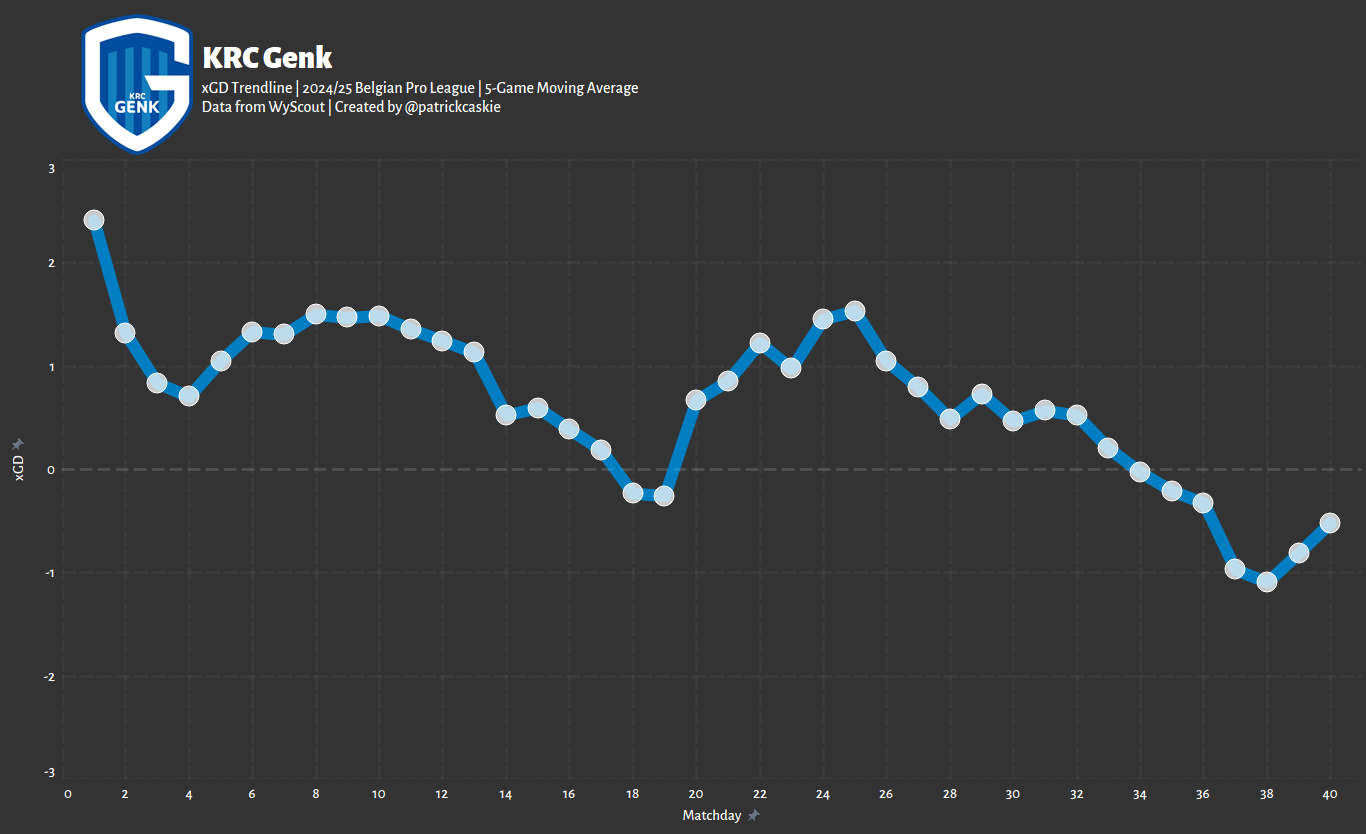
Genk crashed and burned hard towards the end of the season, for long swathes of the season they looked amongst, if not the likeliest to actually win the league, but were usurped by both Club Brugge and USG. Their remarkable start propelled them to the top of the table. Yet, their fortunes flipped when they entered the somewhat protracted 10-game split that concludes the season in Belgium. Fink needed a few words to describe the volatility.
"This team can't handle the title pressure right now. That's my fault."
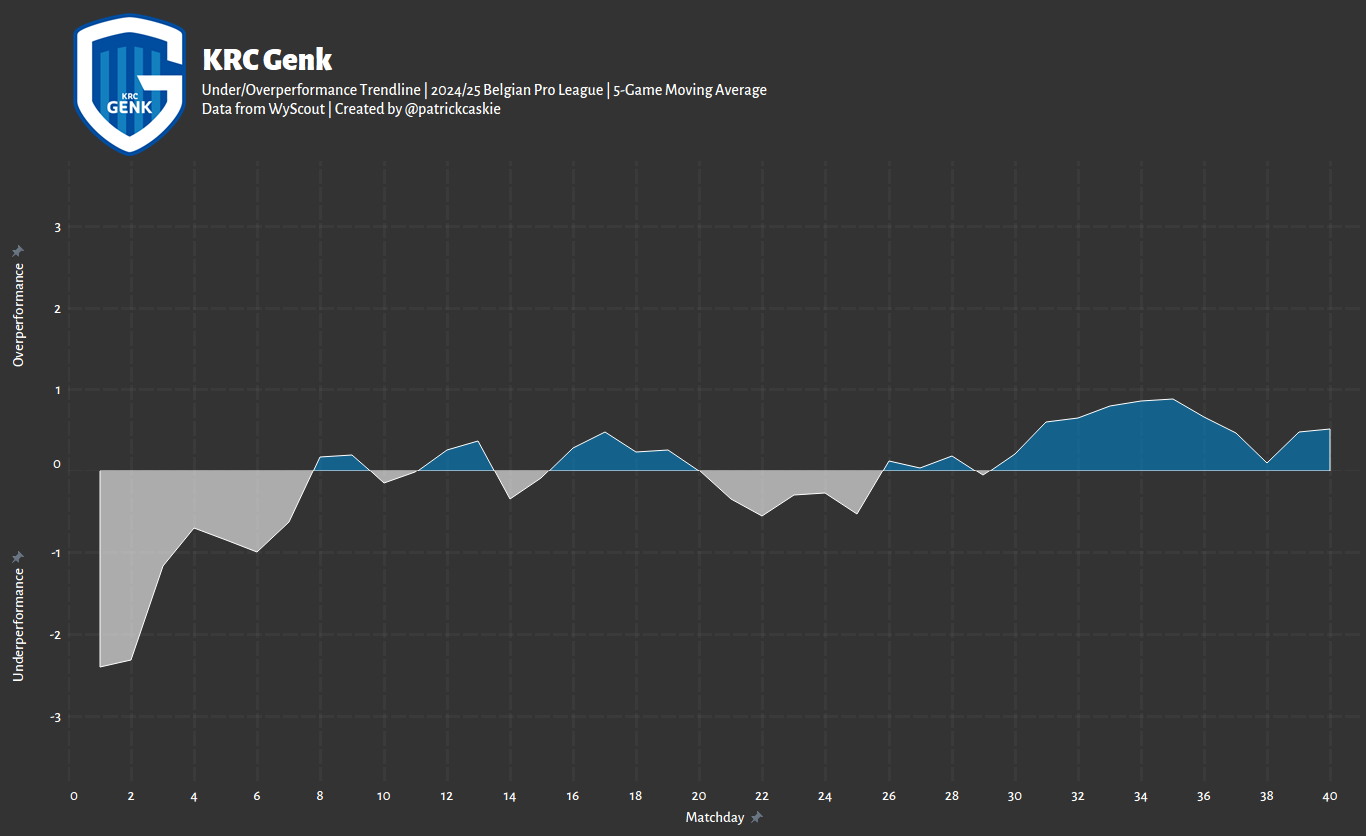
Perhaps more interesting than their crash and burn second half of the season is that their actual fortunes ran opposite to their underperformance or overperformance of underlying numbers. They started hot but likely could have been even hotter, and then once they fell apart, it should have been even worse, overperforming amidst the turgid slide into mediocrity.
Given that the Pro League starts so early, at the time Rangers duel with Genk, the Belgians will have already played eight league games, providing us with enough material to start early sketches of what this season could look like. Below, we have the xG scatter for those games thus far, and outside of a fun trip to Poznan, this season has essentially been a continuation of the slide that began in early 2025.
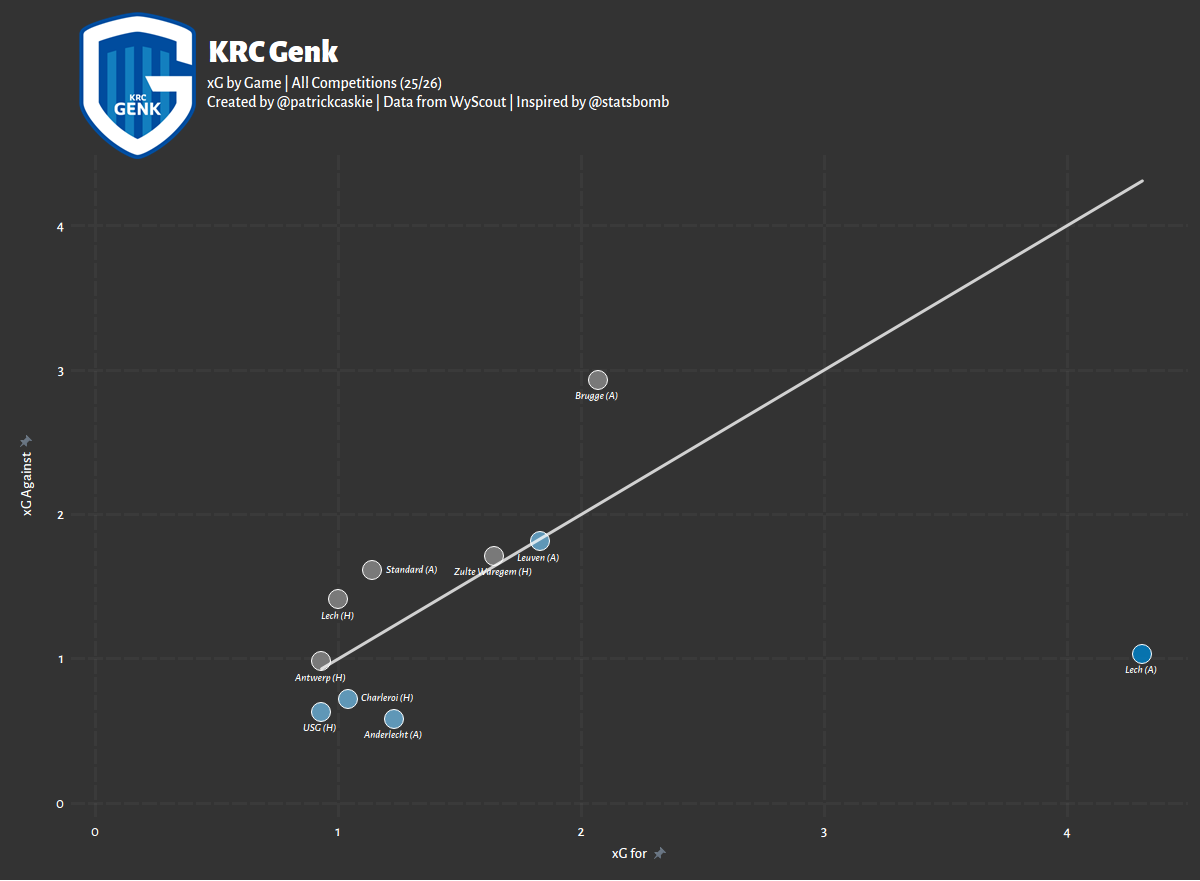
Every game has been a bit of a dog-fight, characterised by a pretty poor defensive record. Unsurprisingly, Fink has fought his corner in media appearances.
"This is a low point, but when you reach the lowest point, you can only go up. We have to pull ourselves up and just get back up.
Style, Substance and Shape
We are early into the 25/26 season - this is what we’ve seen so far.
4231 vs Club Brugge (A) - 27/7/25
4231 vs Royal Antwerp (H) - 3/8/25
4231 vs Standard Liege (A) - 10/8/25
4231 vs OH Leuven (A) - 15/8/25
433 vs Lech Poznan (A) - 21/8/25
442 vs Lech Poznan (H) - 28/8/25
451 vs Zulte Waregem (H) - 31/8/25
4231 vs Andlerlecht (A) - 14/9/25
4231 vs Sporting Charleroi (H) - 17/9/25
433 vs Union St. Gilloise (H) - 21/9/25
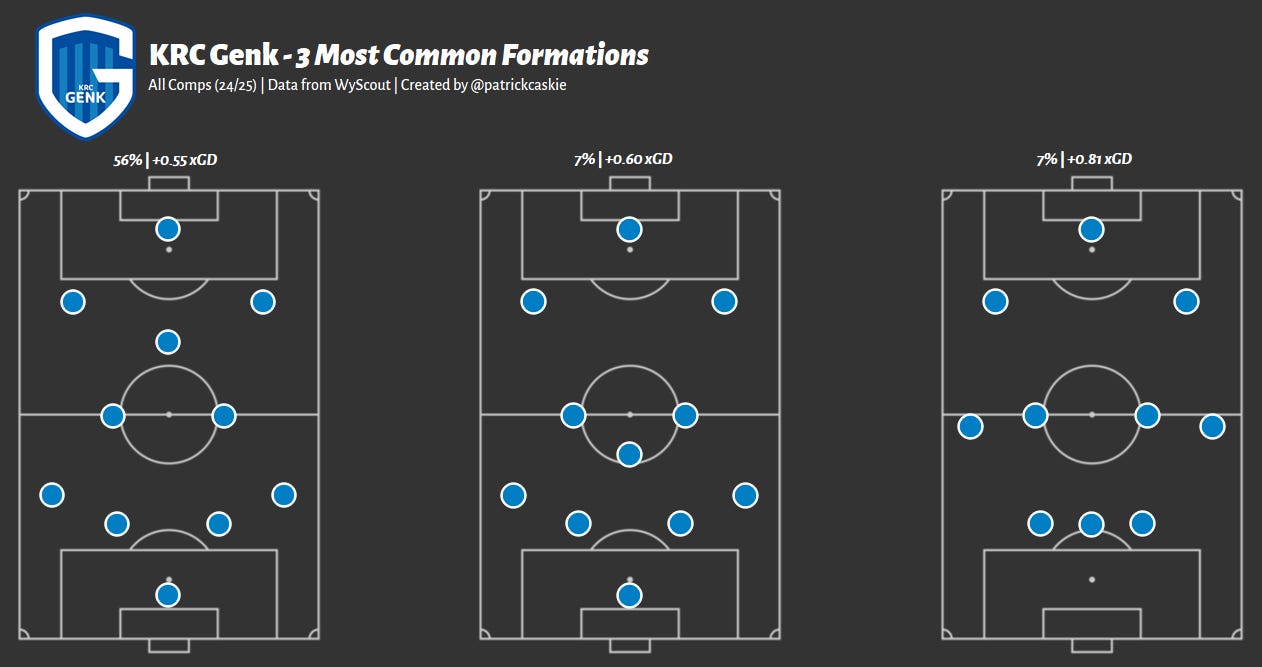
Shapes are dynamic, and formations are, at the best of times, a rough approximation, and diluted a bit further when you're leaning on WyScout positional data. Despite the questionable data capture, Genks' shape has been consistent and has barely budged; it will always be 4231 or a closely aligned variation, as evidenced in the visualisation below.
The only significant variation is the possibility of a 3-atb, which I think we are unlikely to see as the primary shape. Still, we will often see this in possession as one FB tucks in whilst the other bombs forward, more on that later.
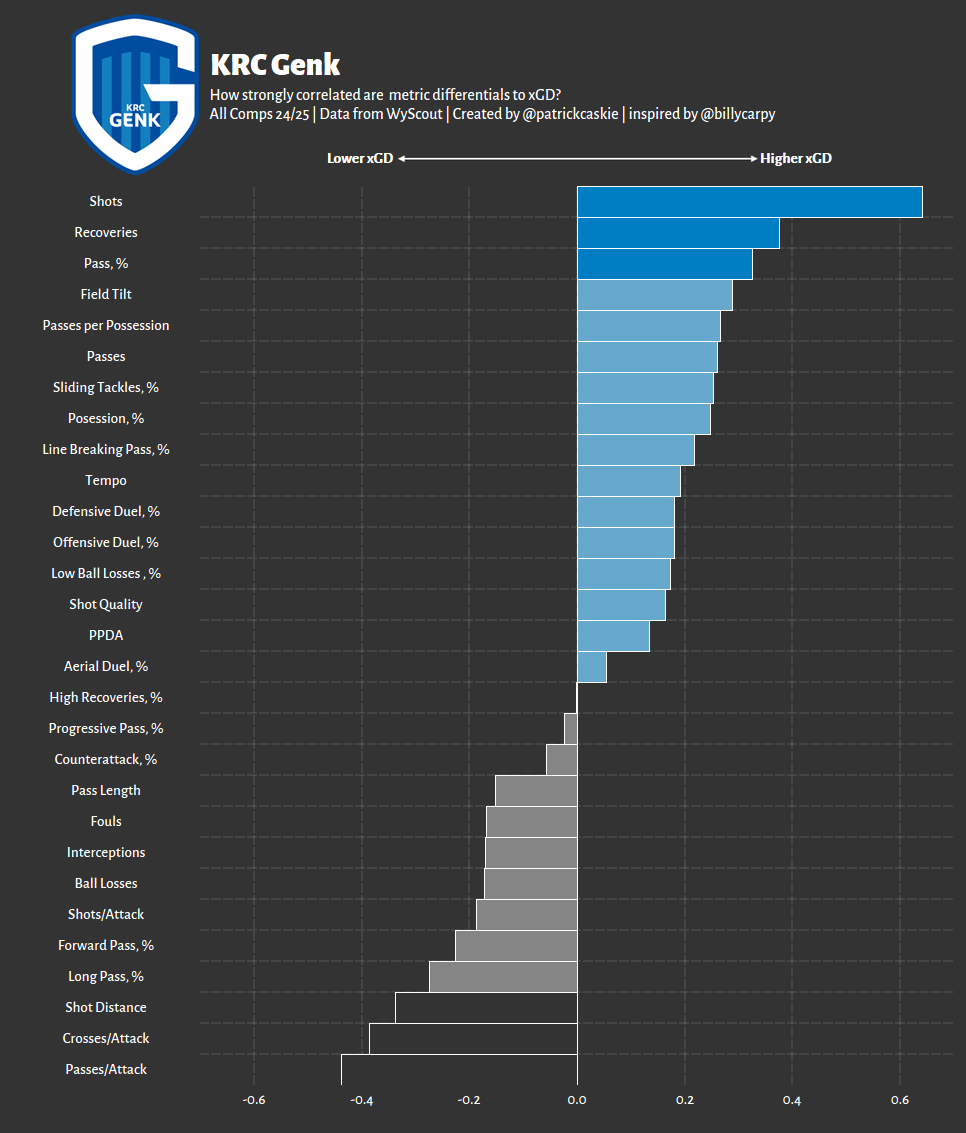
The correlation chart below provides insight into which metric differentials drive performance for Genk, as measured by xGD, during the 2024/25 season.
Much of this is obvious and correlates more with what makes every football team tick, rather than what makes Genk specifically tick. Geml will likely be a bit boring and reminiscent of Burgge and Panathinaikos, as they are good in a more orthodox possession-heavy way, as opposed to, say, what we found out about Plzen previously (see below).
So, what can we say with relative certainty about this Genk side?
Quantity over everything else. Shot quantity sits far and above as the strongest correlate with qualitative measures, not really pushing the needle, suggesting a game model that doesn’t hinge on creating rare, high-quality chances, but sustained pressure.
Control the ball, control the score. Territorial metrics are key predictors of success; their game model is predicated on maintaining possession and passing lanes in a maximal sense, further evidenced by indifferent or negative returns for pass length as well as long and progressive pass shares. This shouldn’t surprise:
“I'm also someone who likes short passes. It's important that the players understand that if they're positioned 5 meters higher, lower, or further inside, that's much better for playing in possession.”
“It's important to me that my teams are courageous, play active football, and control their opponents. Possession isn't the goal in itself, but rather a means to get the opponent moving, create space, and maintain the initiative.”
Tempo is key. Maintaining a higher tempo in and out of possession is a strong correlate for success; setting the tempo and playing the game accordingly is a clear KPI for the side. To me, it seems that this may be the defining identity thread across opponents, good and bad, as they will not always try to control possession but will more often than not look at the tempo and pace of play as something they can
At the same time, I ensure that my teams can act flexibly. Modern football demands that you can adapt to different playing styles without losing your identity.”
Counterattacks are overrated. This shouldn’t be a surprise given the other findings, but could be important come Thursday. Genk are not a side that prefers a counter/transition-based offence, or at least are not successful in games where that is their primary method of attack. This obviously correlates to opponent strength, but it suggests a side that may not be comfortable, such as Slavia coming to Ibrox and sitting, then pouncing.
Let’s shift from what correlates with success to a closer view of how Genk plays.
Genk is a possession-dominant, shot-happy side that controls the tempo and the rhythm of matches through its in-possession efforts, but adopts a slightly more reserved yet still robust approach out of possession.
Wait, that’s word-for-word what I wrote about Brugge last month, and yet it really, for the most part, looks correct for Genk, albeit with a lower ceiling,
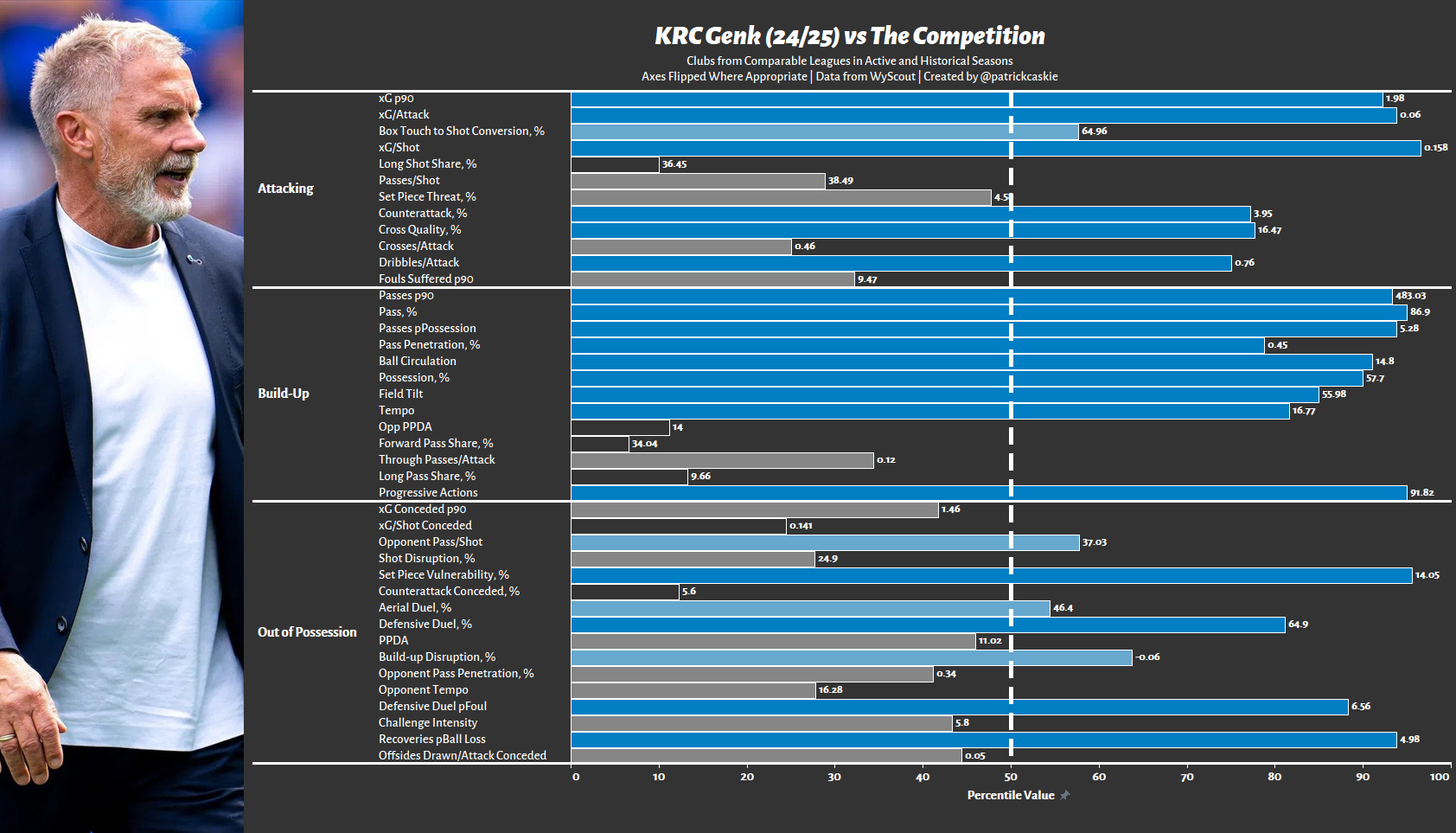
It’s pretty remarkable just how similar the percentiles are and the shapes they form. I didn’t really want to do this, but to save time, you can either interpret the graphic above and come to your own conclusions or read the corresponding section in the Brugge and substitute the team names.
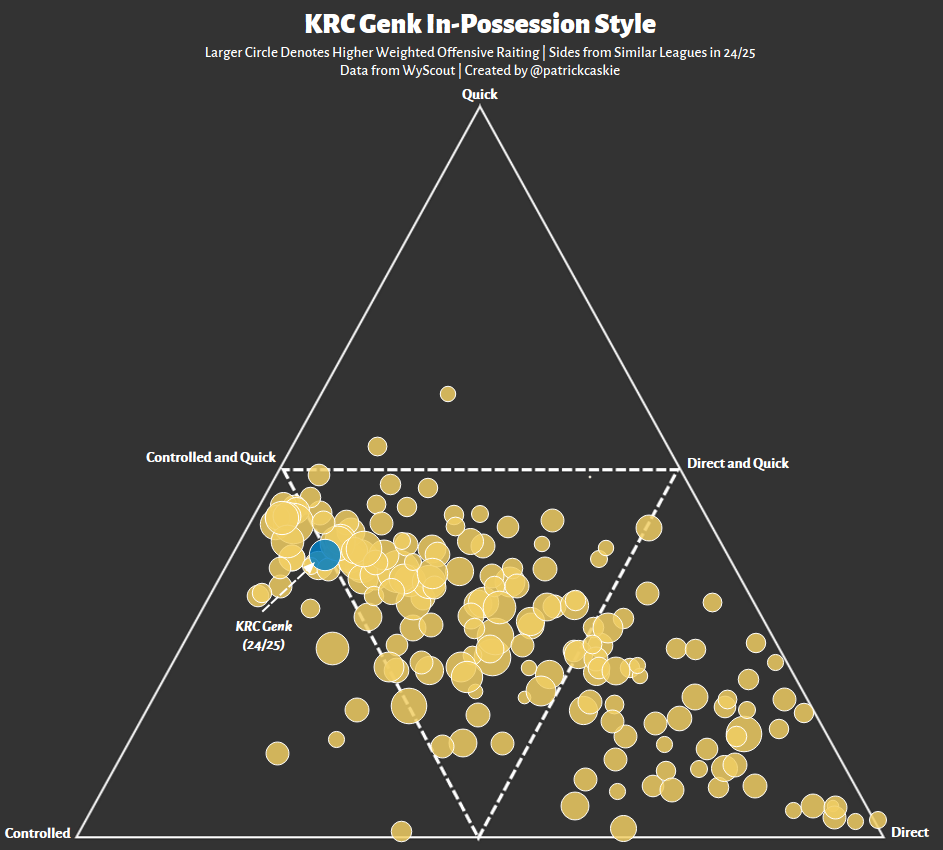
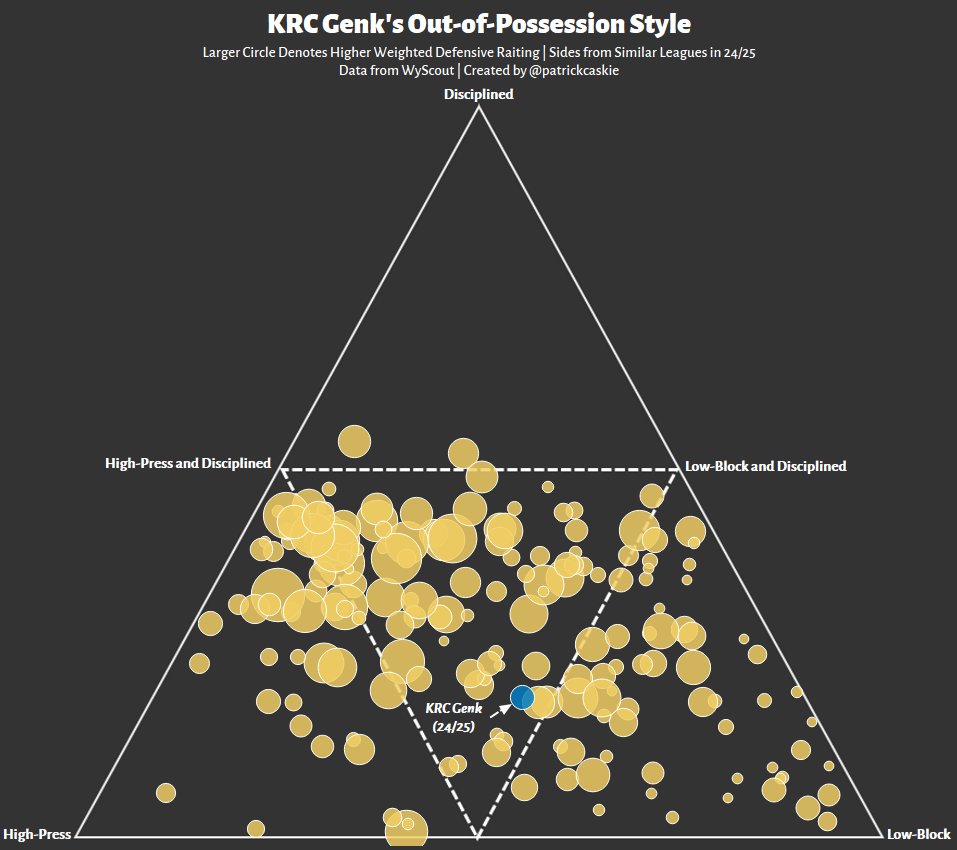
Much like the bars, the ternary plots read a lot like old foes Club Brugge.
The ternary plots below aim to provide a macro-view of team style, both in and out of possession. First, let’s address in-possession.
They’re focused on control, playing lots of passes at a fairly quick clip, and enjoy long possession chains. Like Brugge and previous Rangers sides, it’s high-possession but not dogma.
Out of possession, Genk are relatively pragmatic. They’re not a press-high-at-all-costs sort of side, yet they are not a guaranteed low or mid-block for 90 minutes. They have the tools and demands to do both at different times, and we are likely to see a mix across the 90 at Ibrox.
Fink himself even sends mixed messages at times, which, taken in good faith, are not the ramblings of a contradictory speaker but are valid points made at different times. Below are the differing takes on the importance of rest, defence, shape, counter-pressing, and intensity. Even the best of teams cannot have it all; it's horses for courses.
It's important for us to be in good formation there, because if we lose the ball, the opponent can't counterattack. If we lose the ball up front and aren't in good formation, we'll get counterattacked, and that's always bad. These things are often practiced and improved with video analysis.
Klopp's saying applies to us: "The best way to have possession is to transition after losing the ball and then winning it back to attack." We train this intensively and create many chances from the opponent's disorganization when we win the ball back.
As we have done previously with all our European opponents thus far, comparing them to familiar foes of the recent past who share the same league will help us generate a clearer picture of what to expect, albeit imperfect.
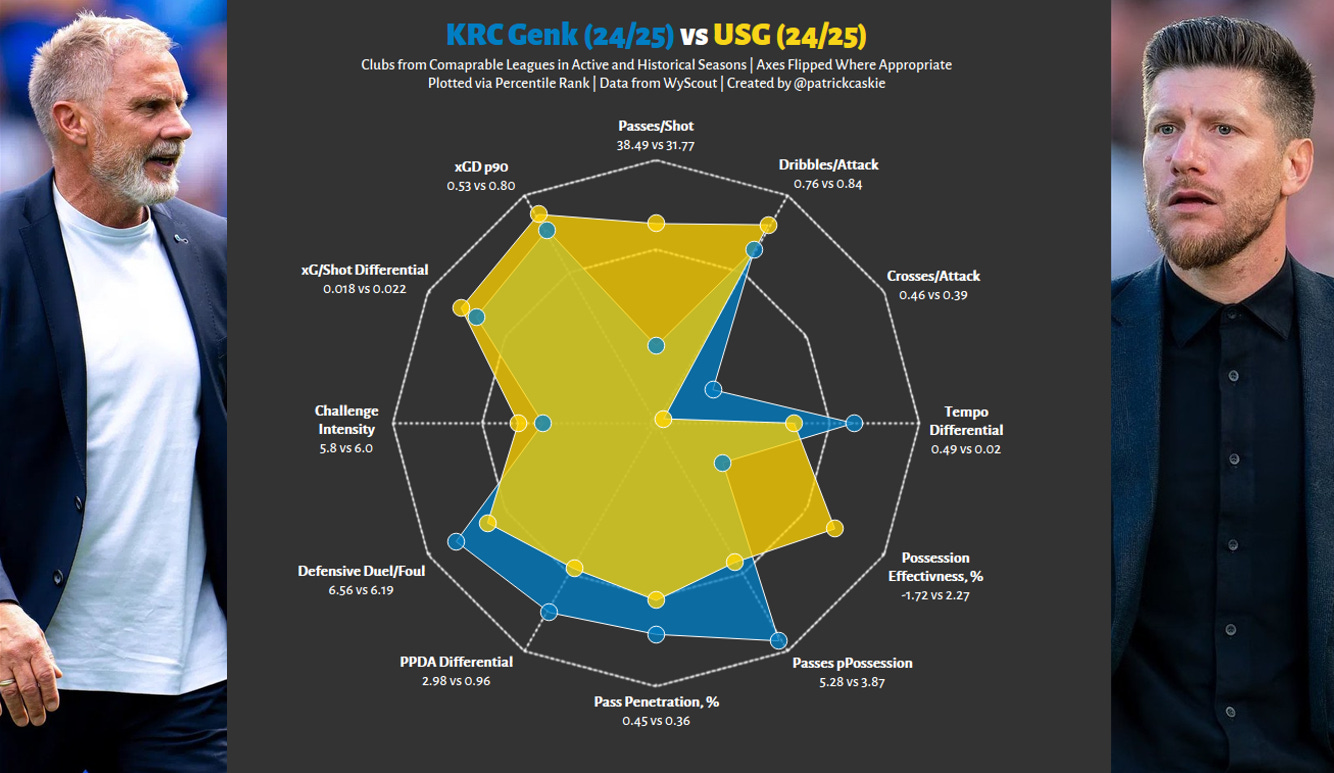
The comparison is largely as expected.
Genk places a premium on controlled possession, plays with a higher tempo in and out of possession, and is less direct and is a slightly weaker side according to xGD. Much like with our previous comparison between Brugge and USG, the PPDA differential does leave some information out.
An interesting point is that, despite the far higher PPDA differential, communicating that Brugge are more aggressive out of possession than their opponents, USG are more aggressive out of possession. This is due to the basement level of Brugge’s opponents (much like Rangers), whilst USG are faced with a more active higher-line.
With respect to the sort of style that Rangers would be best facing, I think a good version of Genk poses a more difficult proposition than USG, but an out-of-form Genk is a more fallible foe than a poor version of USG. Genk is more likely than USG to attempt to go toe-to-toe, given their relative strengths, which, if done well, can totally disrupt our style of play. In contrast, USG is always likely to afford us an extra step and pass; on recent evidence, this might be to our own detriment. Yet, regardless of execution, it provides us with a runway to develop momentum.
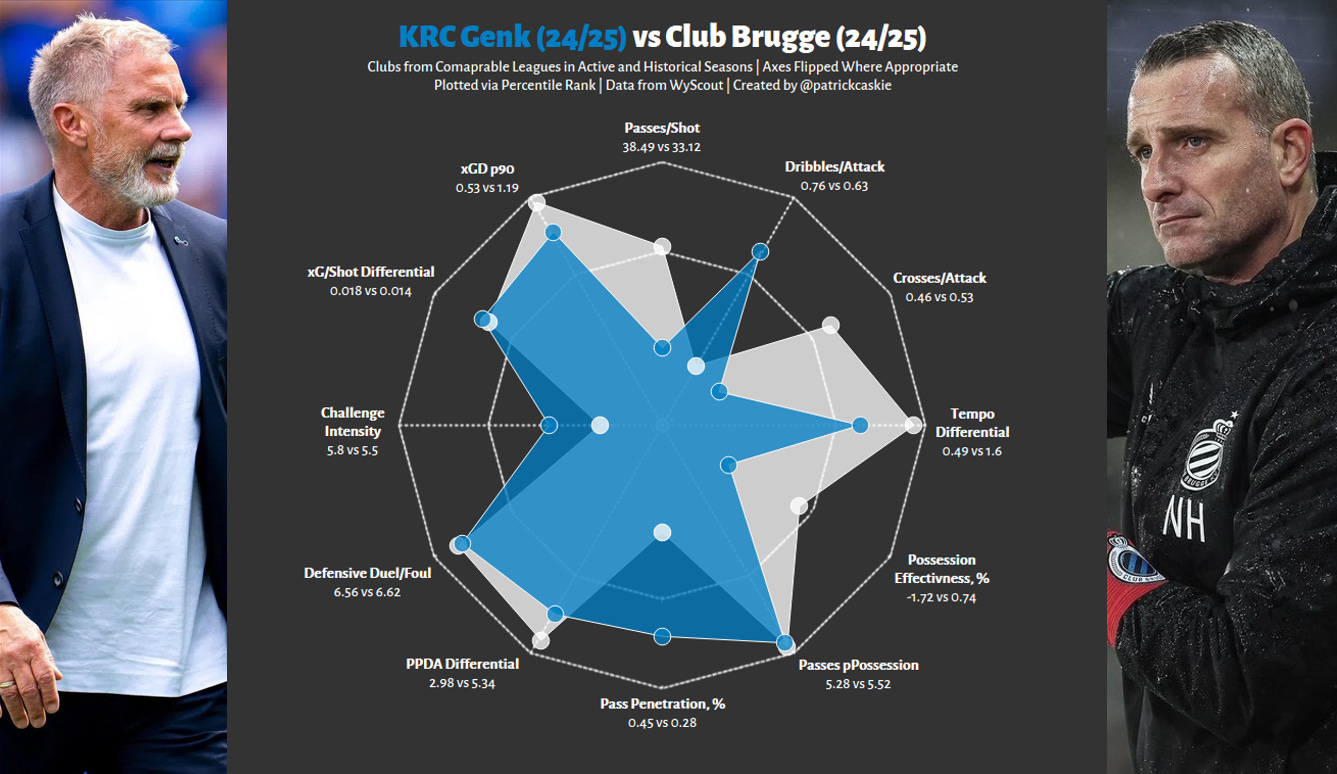
The Brugge comparisons are simple. The side that nailed us 6-0 is a far stronger side than Genk, and they are stylistically similar, albeit with a slight divergence in whether wingers are primarily dribblers or crossers. The concern is that, should it click for Genk, they have the requisite quality and game model to tear us apart, should Murphy’s law come to play. Still, they won’t, or are at least two Rangers red cards away from being as dangerous as Brugge.
Positional Queries and Players of Note
A New Name in Net
"With Courtois, Casteels, Vandevoordt, and Penders, among others, we've recently developed some fantastic goalkeepers here. I'm really looking forward to working with the goalkeeping coaches here and hope to follow in their footsteps and be just as successful for this great club."
As mentioned earlier, Genk enter the 25/26 season with a new name in net after the departure of the excellent Mike Penders. Despite being a few years his senior, Tobias Lawal has set his sights on emulating the now Strasbourg no.1. Lawal, a recent debutant for the Austrian national team and long-term LASK prospect, moved to Belgium for €3.20m after a set of credible seasons as no.1 in Linz. The graphic below traces a rough proxy for pure shot-stopping ability, and Lawal, outside a sizeable slump a season ago, has been in excellent form. Notably, he was amongst the best, if not the best, in Austria in his final season.
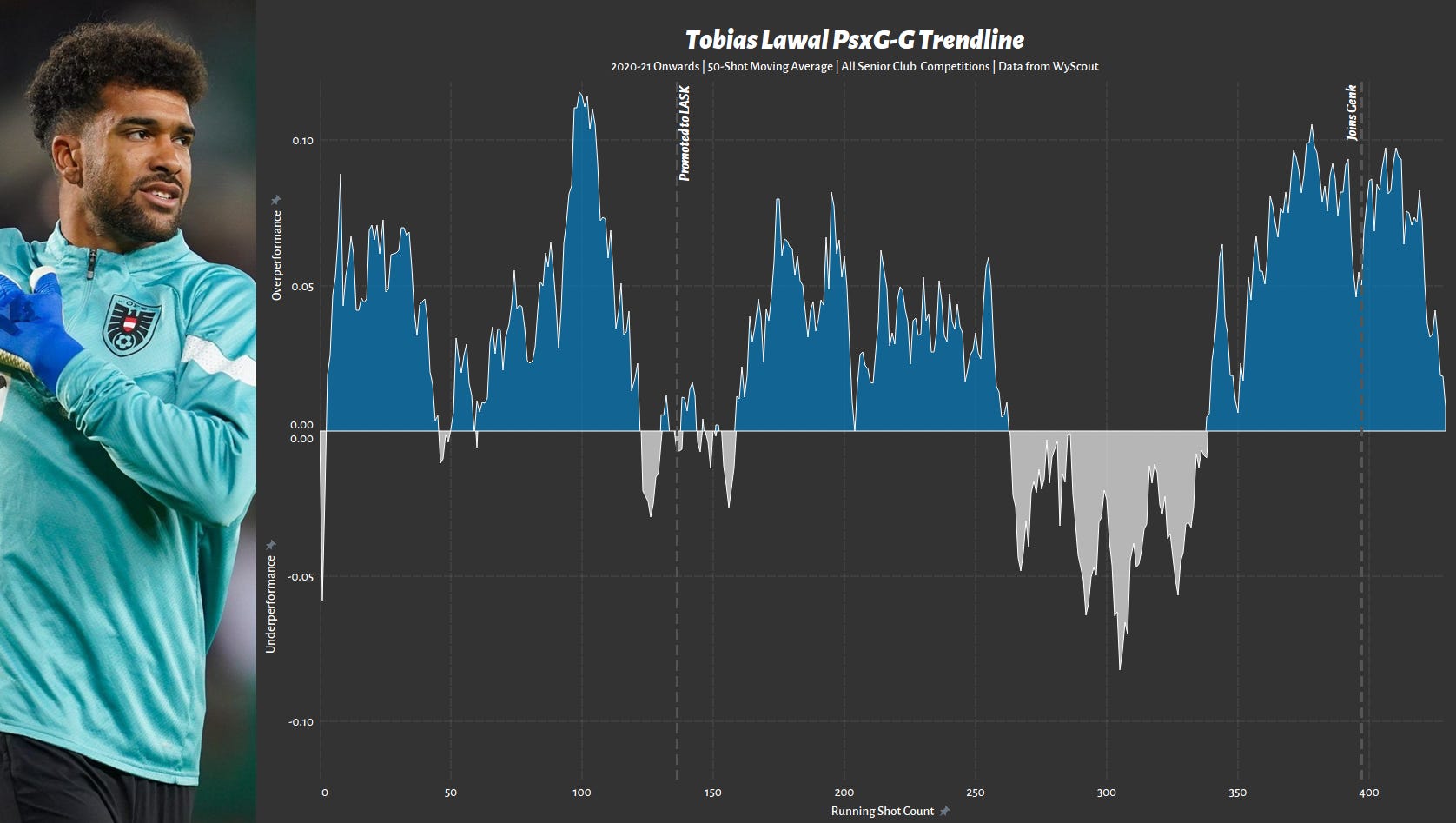
Let's compare his performances to those of Penders’ last season. It seems that, should he translate more than 90% of what he was able to do in Austria, Genk will have found a suitable replacement, albeit without the seemingly limitless potential that Penders has. Tactics, rather than talent, often determine a goalkeeper's non-shot-stopping role; hence, reading into the idea that Lawal is a far superior sweeper is naive. However, we can say that Lawal is comfortable assuming such a role.
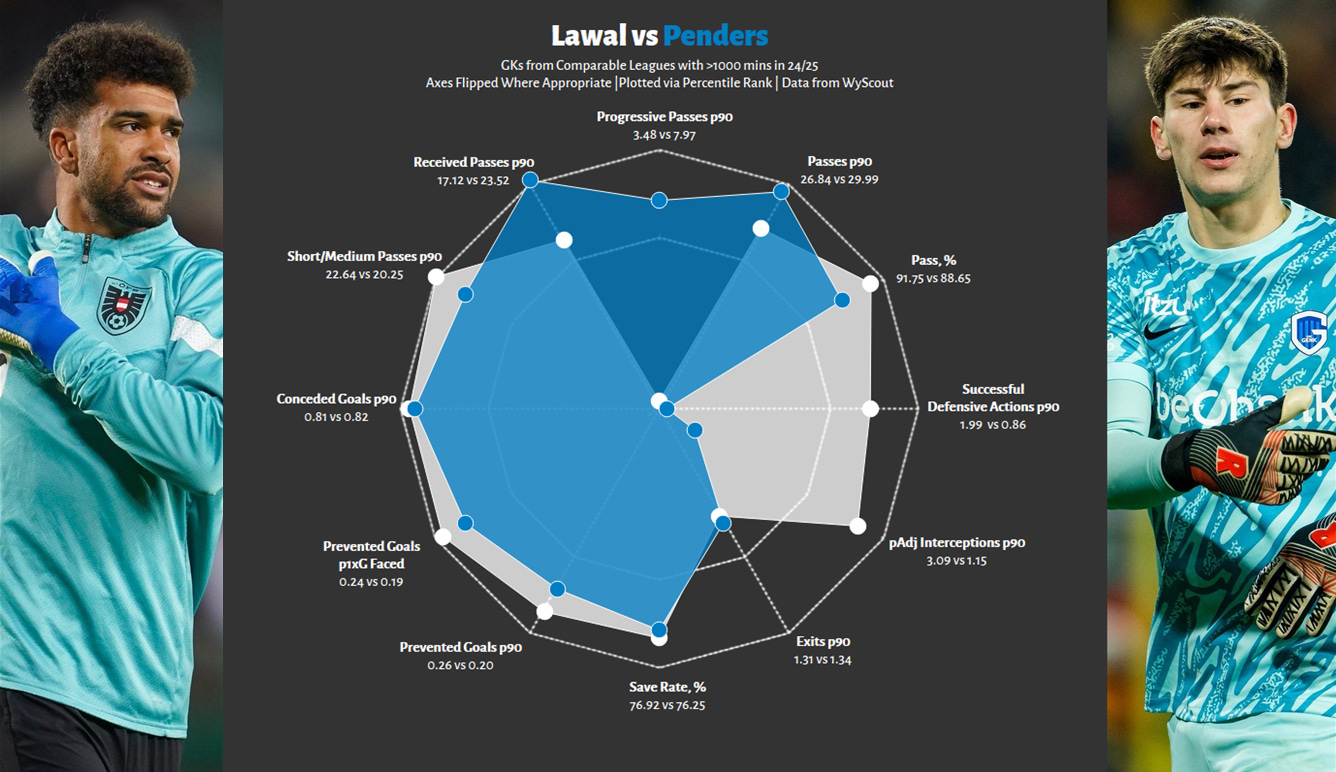
Even if Lawal fails in his conversion, Genk likely has either the best or, at the very least, the most experienced backup in the league, Hendrik Van Crombrugge. The 32-year-old has over 200 Pro League Starts and was Anderecht’s no. 1 for two seasons in the recent past and hit almost 2000 mins last season. Genk’s dynamic was less clear-cut as a no. 1 and backup, and more of a 1a and 1b, which is likely to continue.
Lawal is good and has been capable of shaping the outcome of matches on his own.
Smets x Sadick
Like with most areas of the field, Genk have, in recent times, had a serious conveyor belt of CB talent; Kalidou Koulibaly and Jhon Lucumí are the standouts.
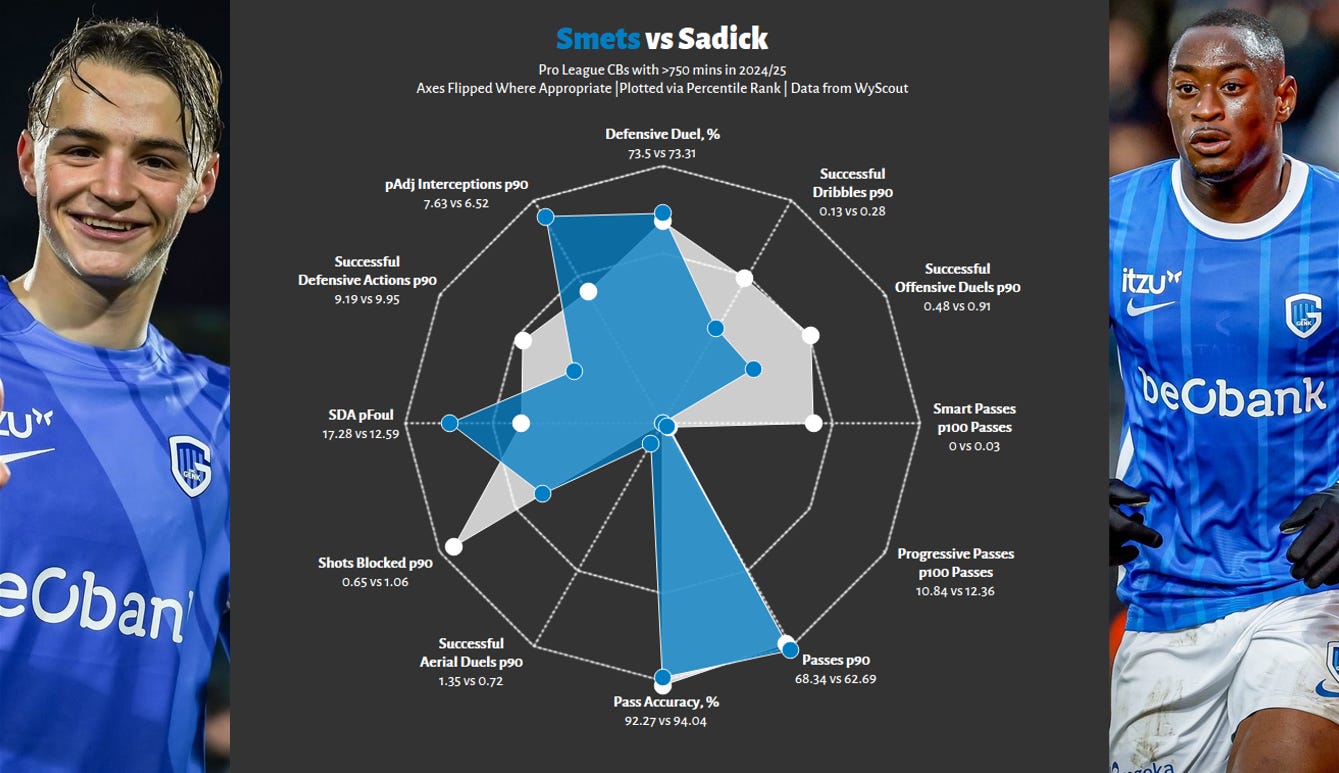
Despite a squad-wide struggle to keep the ball out of the net, Genk’s CBs, especially the young Belgian Matte Smets, are impressive players who will more likely than not follow the well-trodden path set by those before them. We will examine both individually. Still, as mentioned many times, you are remiss not to first read the pair in tandem, given how much your partner dictates how, where and what you do on the pitch.
Caveating with obvious drawbacks of capturing defending via data, Sadick is the more adventurous and progressive partner, more often seen marauding forward, dribbling out of the back and fouling, whereas Smets is slightly more reserved. For one to be aggressive, the other must be conservative, and so on. Neither are progressive passers, which appears to be a system quirk, not an individual shortcoming; they are likely asked to play short to FBs and 6s, being better equipped to progress the ball. The other quirk, which I cannot explain, is the complete lack of aerial duels in either play. I imagine this is partly due to a defensive shape that funnels opponents central?
Although neither player stands much taller than 6ft, should online height records be believed?
Much like with the data itself, the heatmaps of each dovetail with the simple binary: Smets stays back, and Sadick attacks. It’s obviously not that simple, but it works to an extent.
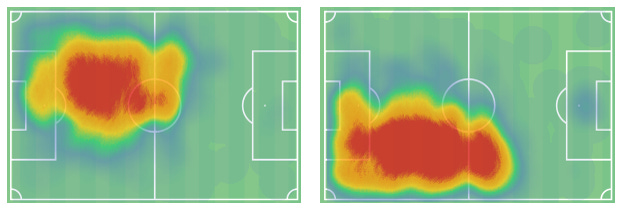
Sadick is obviously a capable footballer and should, true to type, eventually move to a top-5 league. Still, Smets is a more interesting proposition, not least given the teams he has been linked with in the recent past.
"Matte is already a natural leader, we want to give him even more responsibility this season so he learns what it means to be captain at a top club.”
Teams linked Smets in the Last 12 Months - (Sources can be a bit meh)
Aston Villa
Inter Milan
Tottenham
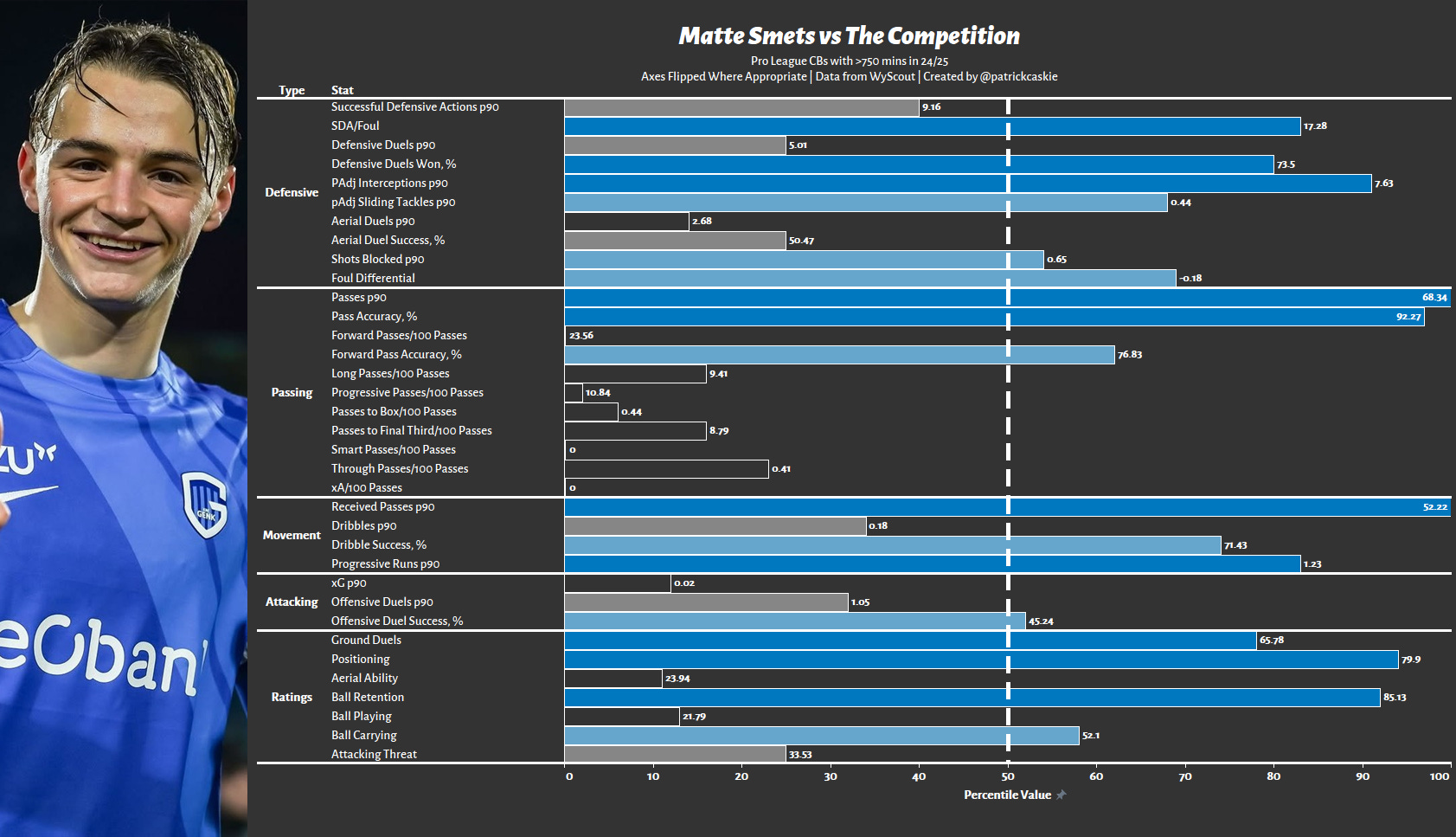
Between the graphics above and below, we can say two things: first, that this is far from the complete picture, a caveat that is needed anytime you use event data to capture a CB’s quality; and second, that for now, Smets is mostly potential but does carry a well-rounded skillset. Given his age, size, and relative lack of comfort in the air, I think you could do worse than asking Miovski or Chermiti, or both, to stick with him and “bully” him out of the game; force him into a bit of a dogfight.
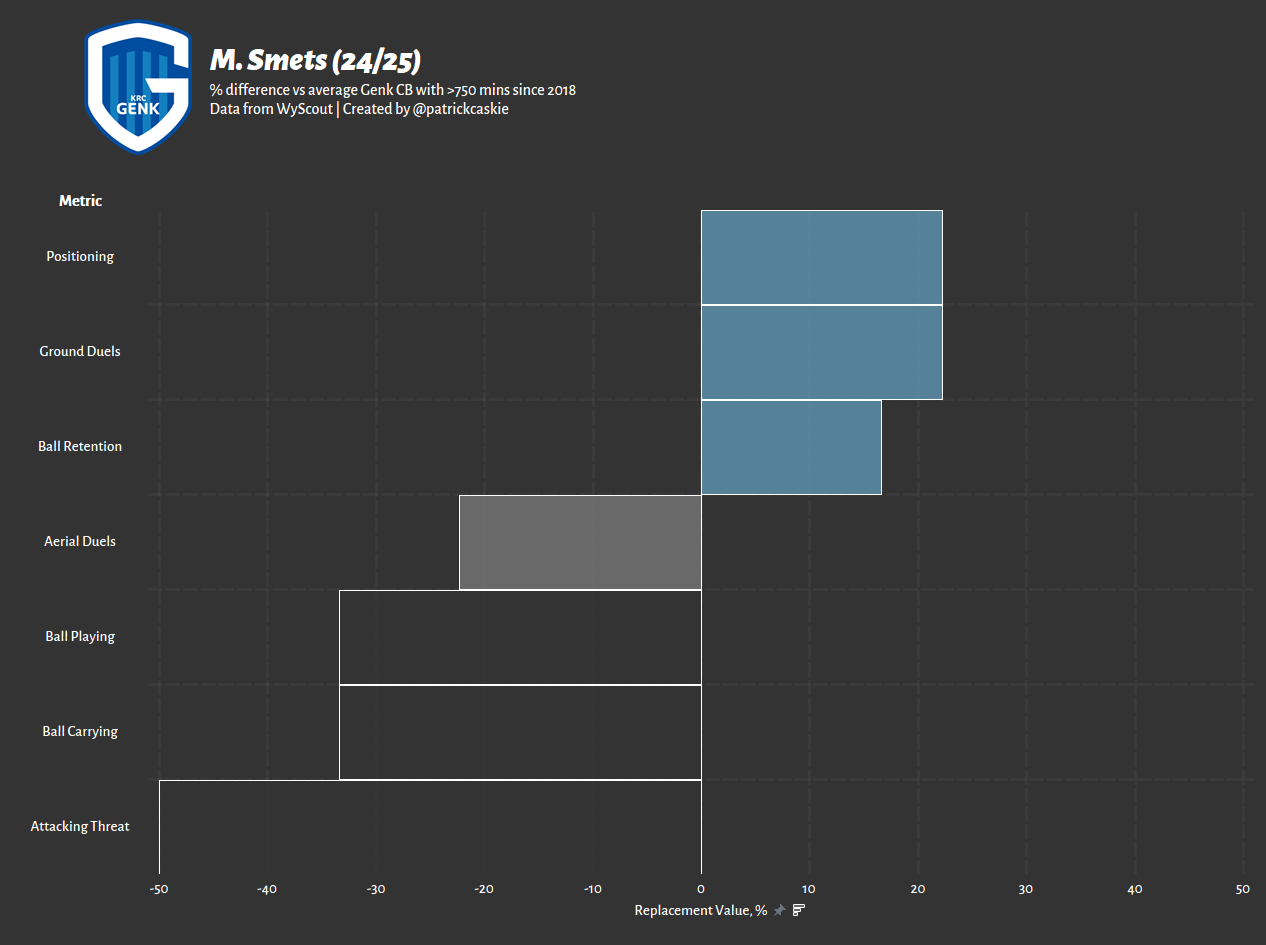
Beyond Smets and Sadick exist several solid prospects, each of whom seems a year away from being a year away, and actively groomed to replace Smets. Academy product Josué Kongolo and 2024 summer arrival Adrián Palacios are 1a and 1b in this regard, but remain peripheral, switching between Genk and Jong Genk on matchdays and are unlikely to do anything but maybe warm the bench on Thursday.
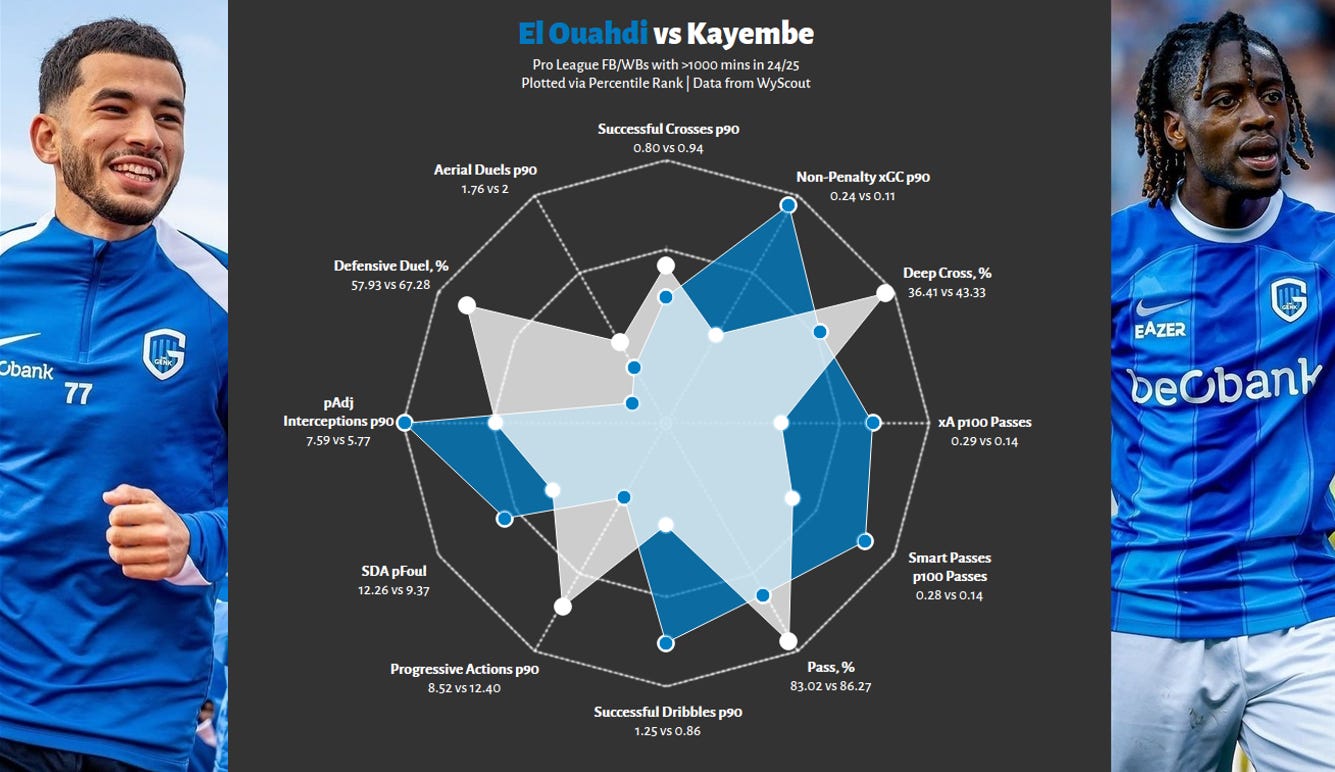
Muñoz 2.0 - Zakaria El Ouahdi
“El Ouahdi is starting to look more and more like Muñoz. Now also with his statistics.” - Steven Defour
Genk’s modus operandi is usually selling on stars of the future, generally aged <23, given this it’s pretty surprising that their most outstanding product of the 2020s is not someone in the mould of Bilal El Khannous - an acamdey graduate who fled the nest young, but a 28-year-old RB who left for what Transfermarkt believed at the time, and what has become undeniably clear, a bargain €8m. Those who watch the English Premier League will understand the esteem one must have to be dubbed the “Next Daniel Muñoz”
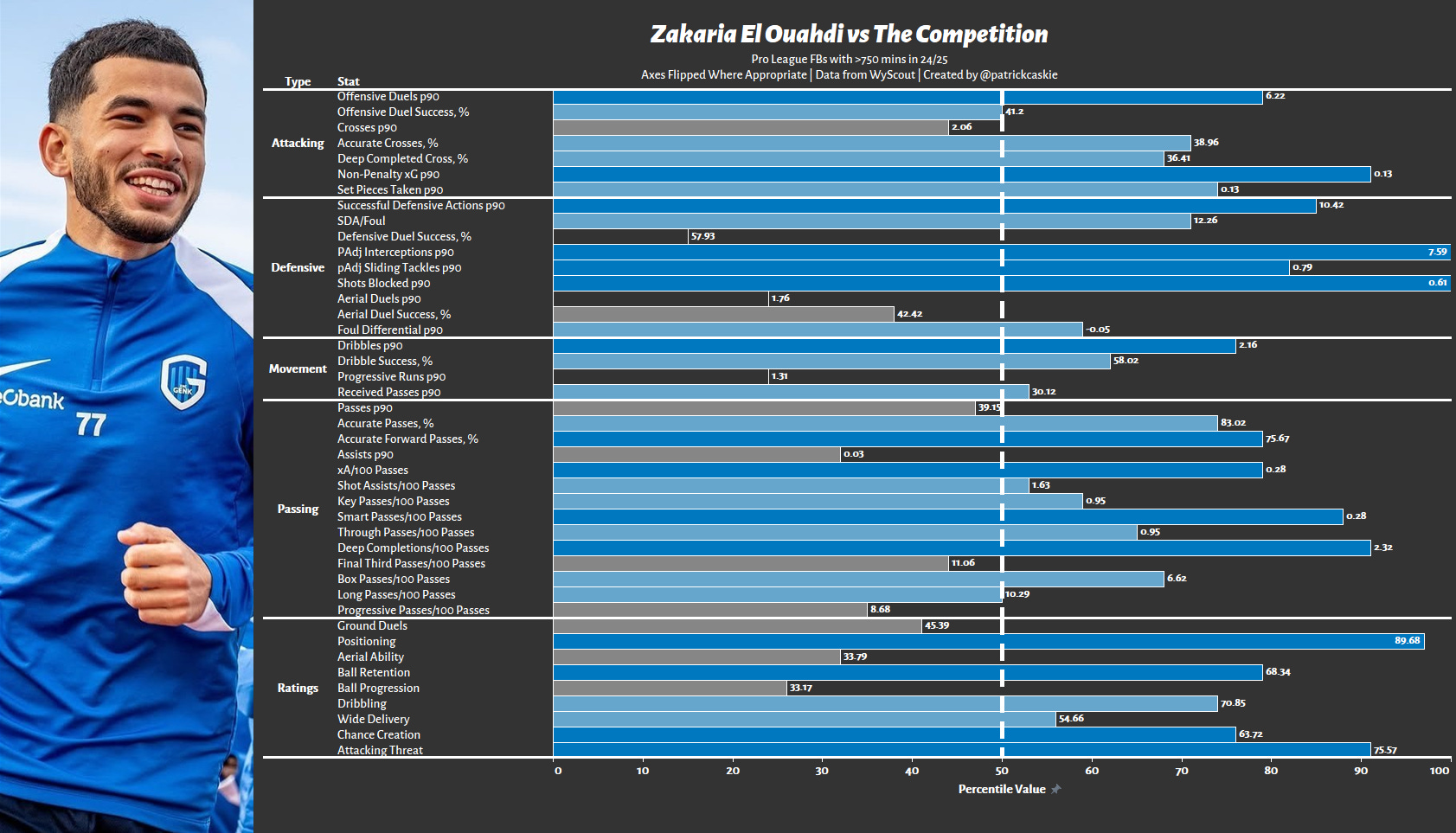
The comparison to Muñoz is merited and extends beyond the new Genk RB versus the old Genk RB. El Oaudhi, like the Colombian, is a well-rounded RB who is more of a wing-back in style than a full-back and is afforded ample opportunities within the Genk system to get forward and attack the box. He's an aggressive defender who's more robust on the ground than in the air, but doesn't fall into the trap of overly aggressive defending and the plague of fouls that accompanies it. He's a good ball carrier and creator, but not an excellent one; he will create and cross for others, but like Muñoz, can almost be characterised as a goalscorer in the final third. He already has four league goals, and it's not even October.
Given his recent success, it’s little surprise to see him linked with several sides just outside and some in Europe’s elite, a similar crop of clubs to a previous opponent’s RB - Georgios Vagiannidis.
Teams linked El Ouahdi in the Last 12 Months - (Sources can be a bit meh)
Stade Rennais
Olympique Marseille
VFL Wolfsburg
SSC Napoli
SL Benfica
Much like with their CBs, we must read Genk’s FBs in tandem to see how they complement and contrast each other. Both are solid in their own right and continue the theme of a slightly more progressive right side of defence (Sadick and El Ouahdi), whilst the left side is still capable but slightly more reserved (Smets and Kayembe). Expect El Ouahdi to be the option, should he play, that drags play forward and, at times, may even play akin to a winger or No. 8, while Kayembe is slightly more reserved.
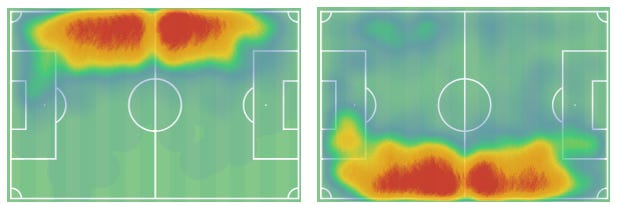
Heatmaps once again confirm our suspicions from the data. Both can be characterised as box-to-box in their play, and both do a whole bunch of work across the pitch. The contrasts, few they may be, are fascinating.
First of all we slightly more of a box presence from El Ouahdi, but more importantly, we see a strong stain in his own defensive box which suggests one of two things; either he at times plays RCB or more likely, that in build-up he will tuck in to form a three whilst the right-sided no.8 drifts wide, similar to Tavernier at Rangers times.
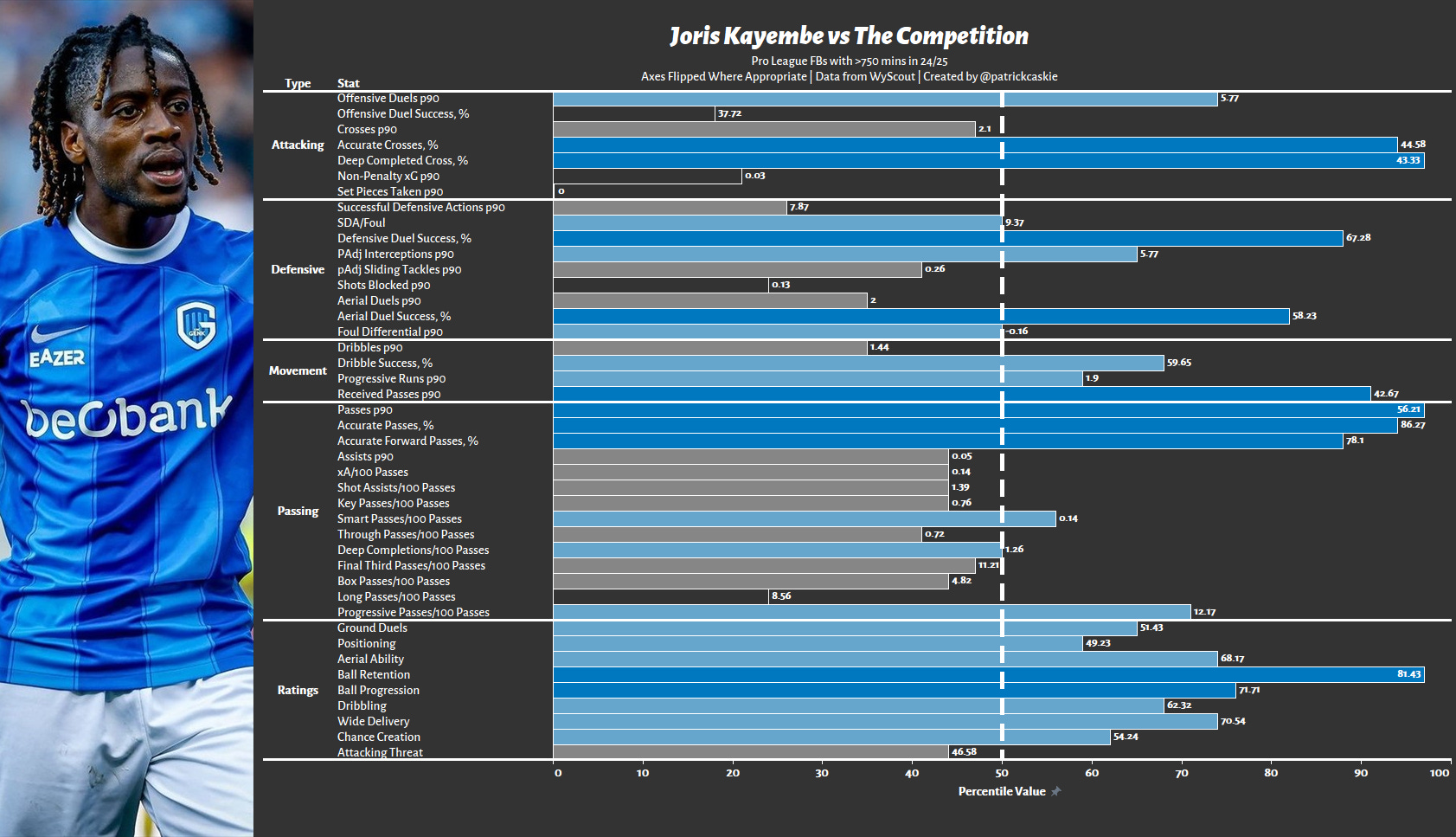
Even if the focus is on his running mate, Kayembe is good; do not forget that. He may like the polish of his junior, but is a reliable option at the back, and larger, although neither is very tall nor wide.
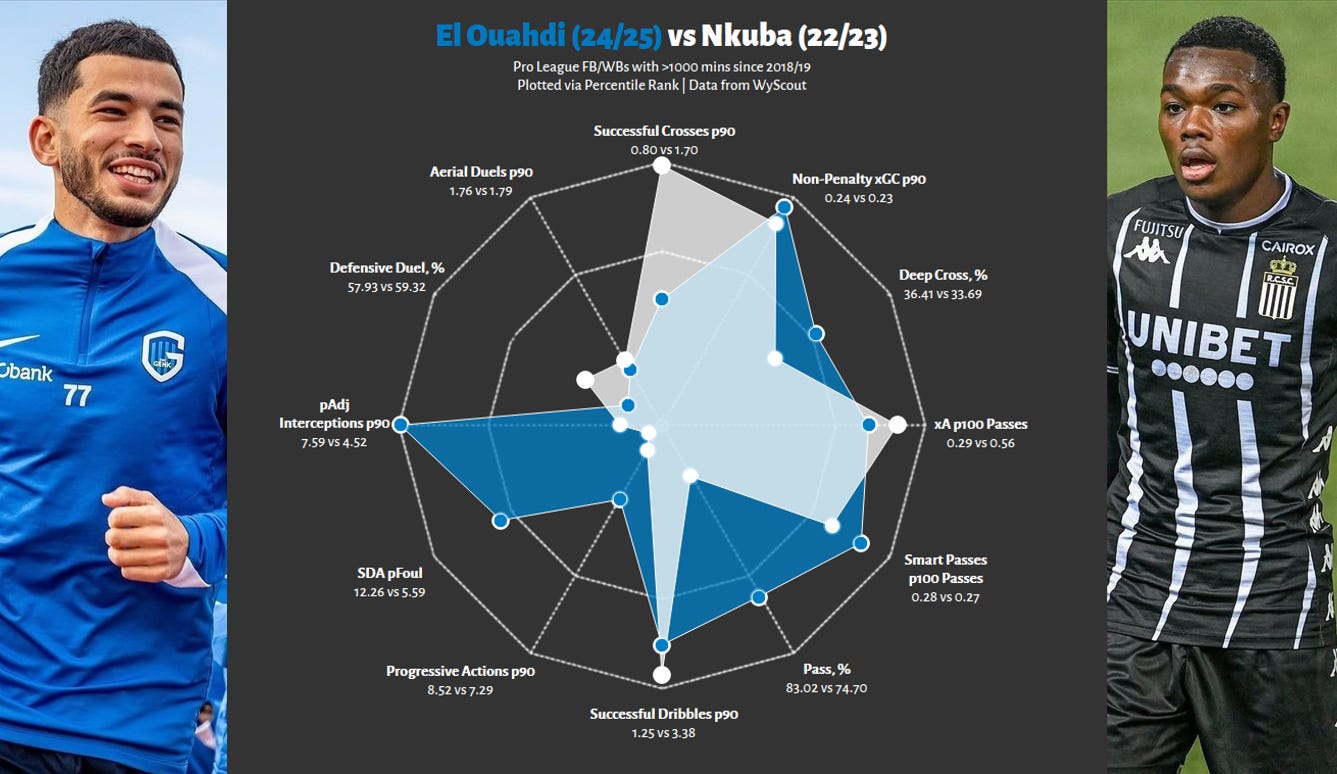
A big wildcard, unlikely to see much of the field, is Ken Nkuba, a pure wing-back who joined as a top prospect from Charleroi two summers ago. Funnily enough, he really hasnt played enough at Genk to generate a radar of his own, so we can defer to the season that won him his move. He has a good mix of winger skills that could prove dangerous should he be subbed on chasing the game, but is likely to be unused outside of this game state.
Yaimar Medina is the alternative option to Kayembe on the left, but is unlikely to play much. He joined from the reputable IDV academy in January for €4.85m and has made several substitute appearances this season.. Barring a left-field “job-saving” turn from Fink or a late Kayembe pull-out, the Ecuadorian will stay put on the bench.
The Engine Room
Genk’s engine room was left practically untouched this summer, with the departing Aziz Outtara banished from the rotation many months before his “official departure”. What Genk have is a collection of average to excellent players, but many of them do basically the same thing, not least with the ball at their feet, as evidenced by the remarkably tight distribution of players in the passing ternary below. The best are all-rounders, while those who are somewhat limited are marginal line-breakers.
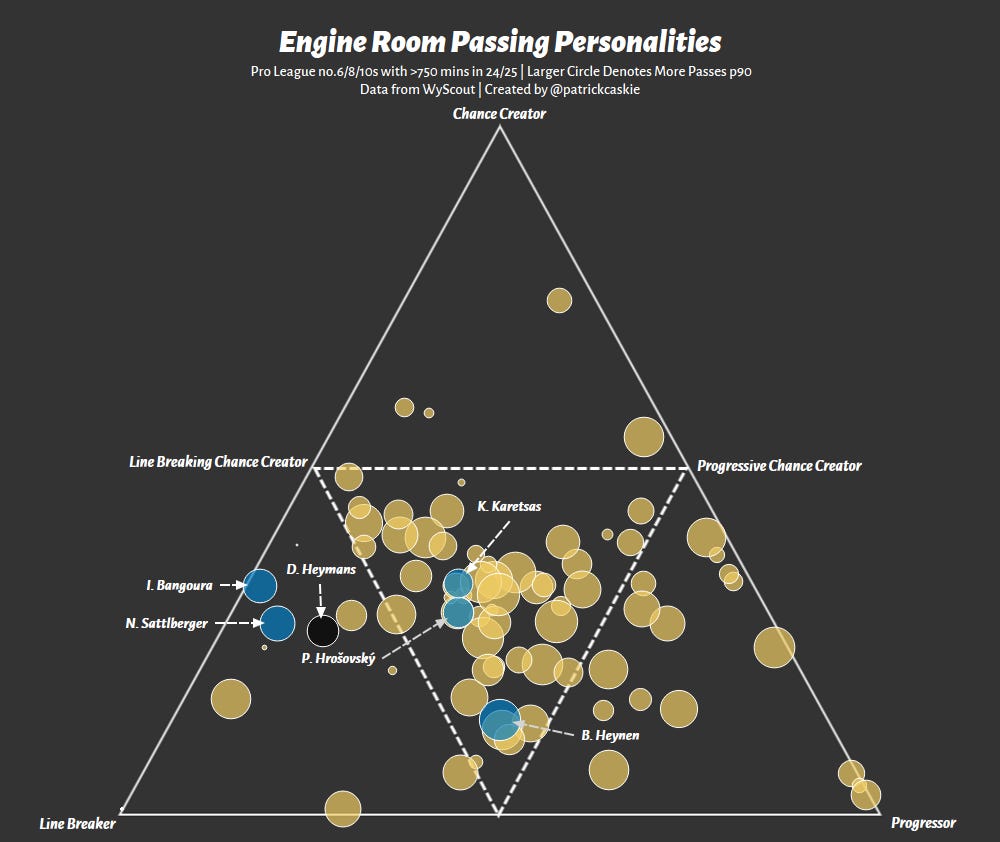
The one player who is a mainstay in any concoction, single pivot, double pivot or no pivot, is Bryan Heynen, who, on a cultural level, inhabits a similar place in Genk as Hans Vanaken does in Brugge; you don’t get the sort of celebration seen in the video below without being excellent and well-liked.
As the percetiles below should make clear, Heynen is a classy all-rounder scoring above the 70th+ percentile for all but one composite rating, yet in the top half for all. The one thing that he doesn’t quite have at the same level as all else is likely goalscoring; however, with these sorts of no.8s, all you need is a goal or two, and you’re in a good place, look at Nico Raskin.
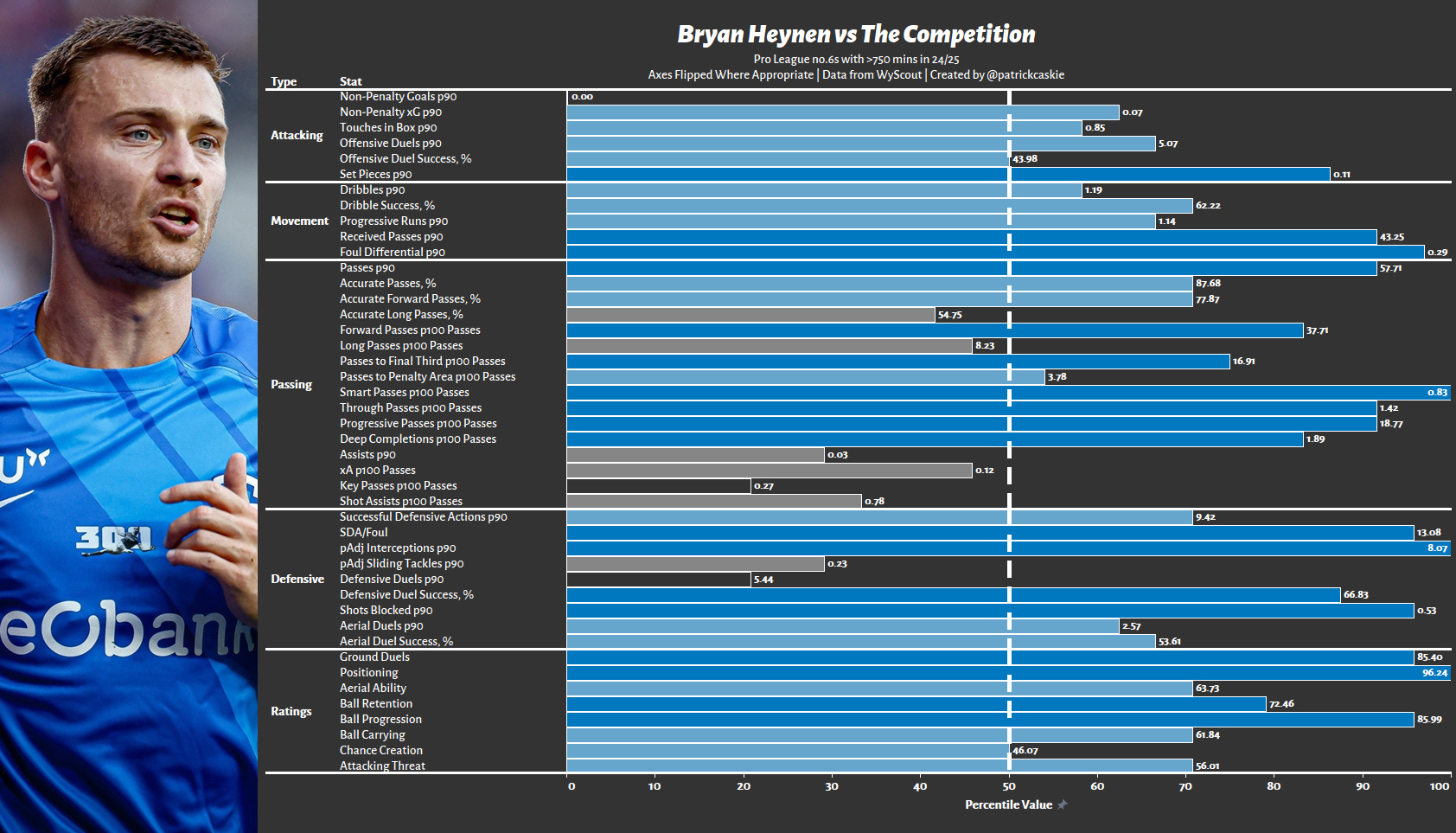
The comparison with Raskin is quite useful, not necessarily in a stylistic sense. Heynen is a more composed and classically attractive footballer, whilst Raskin is far more chaotic and can deal with the bumps and bruises better and give it back, but instead, because they’re both fighting for basically the same spot in the national team. Obviously, Fink backs his boy:
“Bryan is always important, but today he stood out with and without the ball. He still deserves a place in your national team.”
The midfield is built around the Belgian, with other pieces placed around him depending on the opponent and player form. In a purely positional sense, the heatmaps below make this point. If they’re emboldened, they’ll probably pick centre and right: Heynen and once Rangers target Patrik Hrošovský; if it’s more about containment, then centre and left: Heynen and the supposed Newcastle target Ibrahima Sory Bangoura.
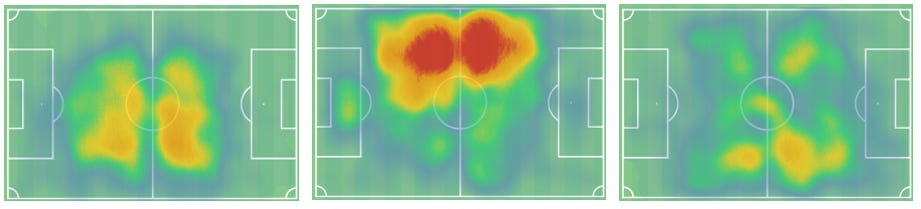
Bangoura is both very young and very exciting, not in a “oh wow, he’s so fun to watch, look what he’s doing now” way, but rather the excitement is formed when anyone thinks about his massive ceiling. For Genk, he plays a relatively limited, albeit important, balancing role when partnered with Heynen, who is more conservative, more destructive, and more anchor-like, akin to the strictest interpretation of a No. 6.
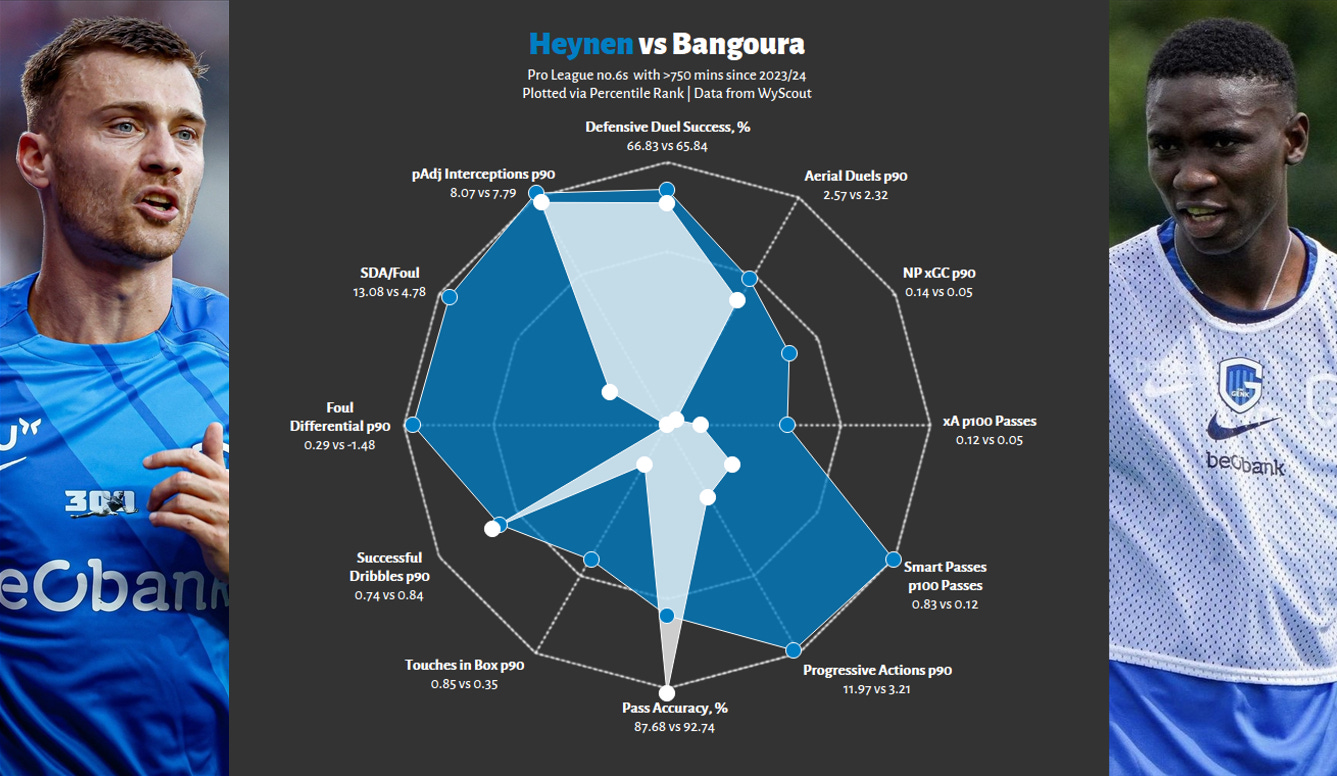
You would imagine Bangoura or another of his ilk will start at Ibrox; yet, if they are emboldened and feel that three points are there to take, then the massively more attacking Slovakian no.8/10, Patrik Hrošovský, will take to the field. The former Viktoria Plzeň star is an effective attacking midfielder; he crashes the box, can hit the ball with pace, creates opportunities for others, and can do enough defensive work to keep everyone in check.
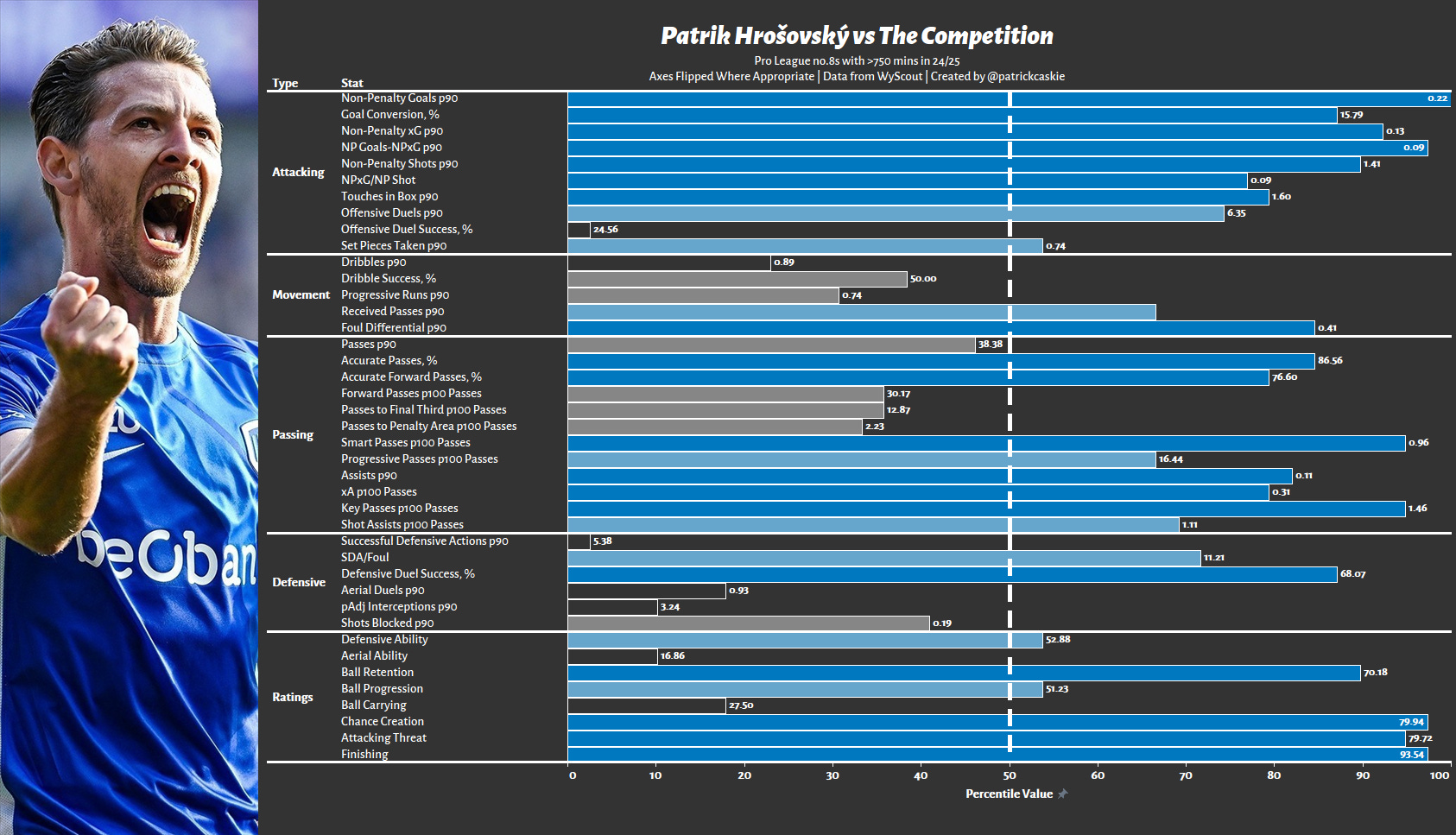
The only other realistic option is Nikolas Sattlberger, a young Austrian No. 6 who played a full 90 minutes vs USG at the weekend. I don't want to pretend that the relatively unsophisticated data I have is the all-seeing eye of truth. Still, for his sake, no graphics should be used, as they don't look good.
The most important thing to note when watching closely for the starting XI announcements is who partners Heynen in the pivot. If it's Bangoura, then the game will unfold in a less certain arch. In contrast, Hrošovský's selection would strongly indicate a side who are playing for nothing less than 3 points.
King Konstantinos Karetsas
Ahead of the pivot, if fit, will be only one man, or should I say boy, wonderkid Konstantinos Karetsas. The 17-year-old, who is apparently a star economics student according to his dad, is far and away the jewel of Genk, and you could make an argument that he is the most exciting player in Europe’s peripheries. Those of you who support the national team will remember what Karetsas offered in his Scottish debut, when he tore apart the national team in March. Given all the hype and obvious talent, Fink’s role is less about making him a better footballer and more about equipping him with the temperament to handle the waves of elite football, as the German did in his own playing career.
"On the one hand, Konstantinos is a huge talent and is being linked to top European clubs. On the other hand, he's only 17 years old, he's in the middle of puberty. If I use him every game, I'll completely burn him out. How can a 17-year-old who's still discovering himself handle all that stress and hype? That's why my motto is to develop young talent slowly and patiently.”
"I don't want to say that every good performance by a young player means he played well. They quickly become... arrogant. But when I see how Kos fought in our last match: I love that,"
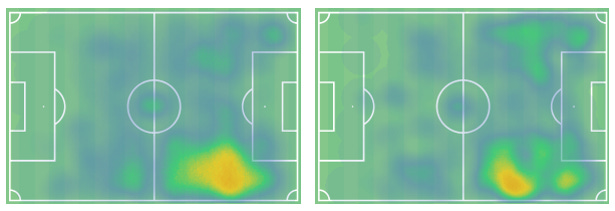
Karetsas is nominally a no.10 but really is a driftor, often taking up positions more reminiscent of a RW, as is expected with a left-footed player, which is made clear in the heatmaps below.
What he does on the pitch is not just impressive against peers of his age, who are very few and play at the level he does, but standouts in any sample. The percentiles below convey a clear message: do not give him any time in possession, be wary of him making a full-out move on you on the dribble, and stop his deliveries at all costs. Given his age and the types of passes he plays, he is due off-nights where it all doesn’t click, let’s hope Thursday is one of them.
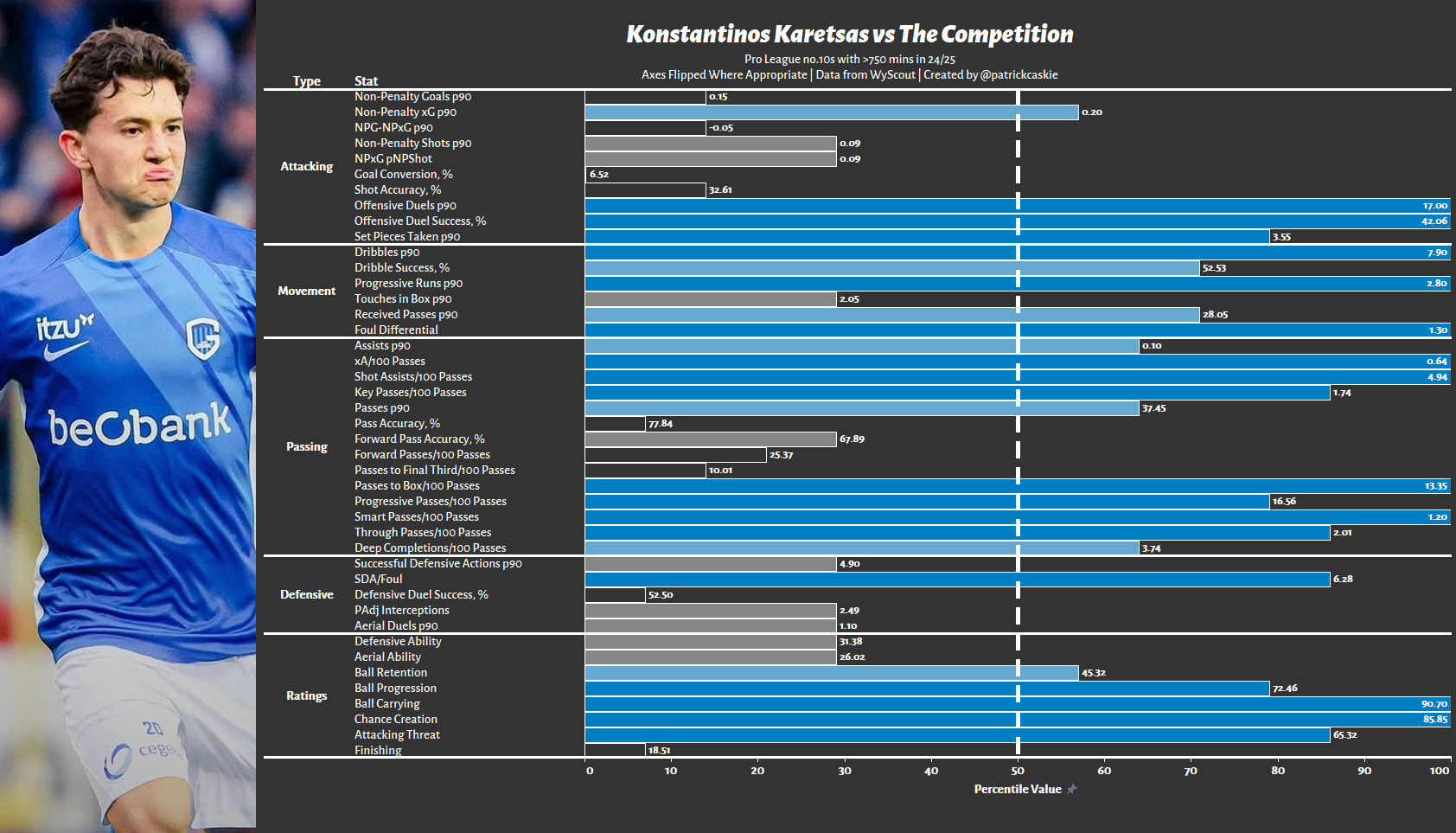
Expect Ibrox to be packed with scouts; let’s not pretend the Arsenal and Manchester City staff are watching any of our boys.
Teams linked Karetsas in the Last 12 Months - (Sources can be a bit meh)
Arsenal
Newcastle United
Bayern Munich
Manchester United
Should Karetsas not make the XI, which is a possibility given lingering injury concerns, the next best option is either Hrošovský playing one up or summer-signing Dan Heymans, who was a standout goalscoring no.10 for Charleroi.
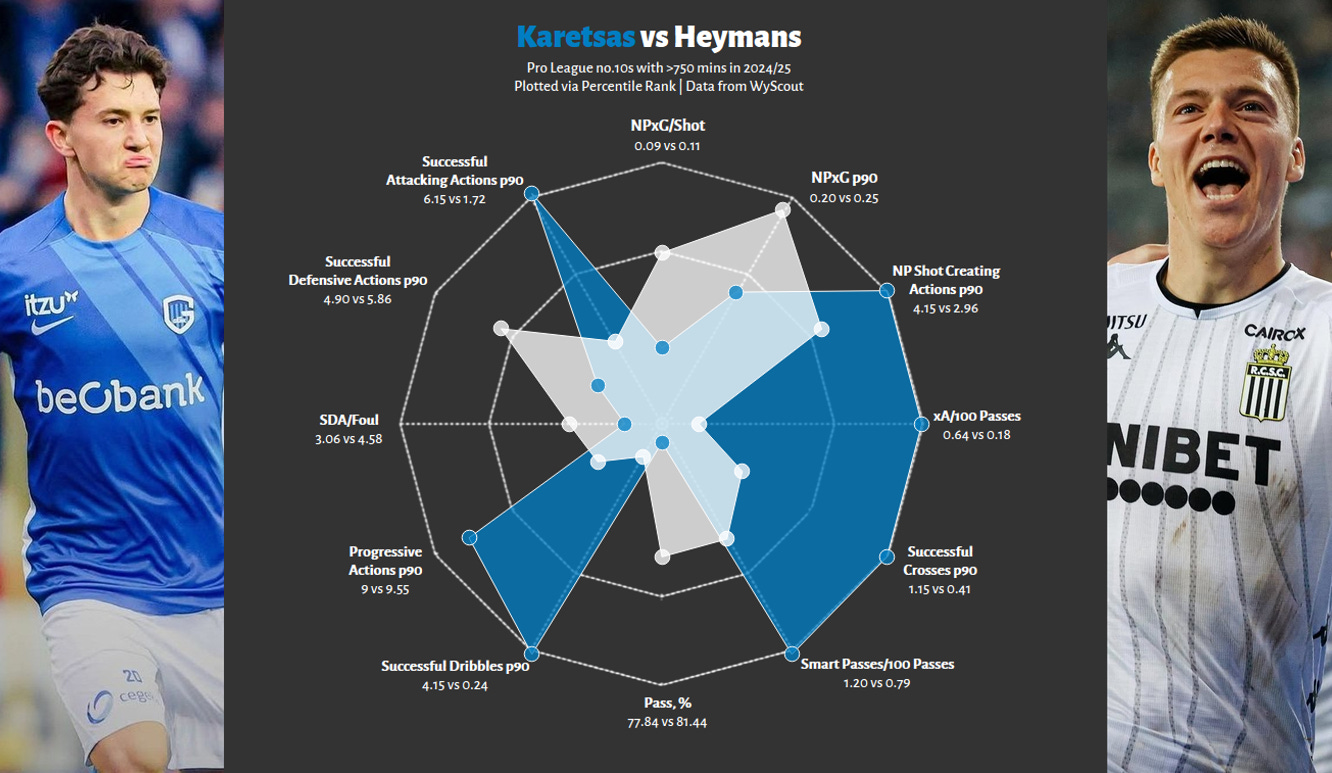
Heymans is an entirely different and preferable proposition to Karetsas; he’s much, much taller and more of a box threat than a final-third creator. He almost plays like a target-man, but just two lines deeper than a no.9, he could be an effective and consistent outball should Genk arrive at Ibrox with honours even, their goal and adopt a more bunker-style approach.
Winger Stocks
“Of course, the players can swap positions, so we remain creative and versatile; especially up front, they have the freedom to swap positions.”
Like any side that regularly plays 4231 or 433, Genk’s wingers largely determine their fortunes. Whilst the Belgians have a couple of standouts, it’s the depth and variety of options, rather than peak talent, that appear most valuable.
The headliner is Jarne Steuckers, who I have seen being referred to as the “Maastricht De Bruyne”, but I’m not sure that’s caught on yet. Obviously, he’s levels below the Belgian, but you can understand the comparison from a stylistic POV. Steuckers as wingers is a somewhat static and athletically average option, but is magnetic in possession and possesses a variety of pass types, as well as the quick cognitive processing required.
“We have good players, we have fast players who can make the final pass, like Jarne Steuckers, who is one of the best players in creating chances in the final third. “
He’s not much of a goalscoring threat, which sees Genk carry only 2/3 tangible scorers in an XI which is a bit light. Still, his ability to create and his usefulness, especially at set pieces, do assuage concerns over goals. If the ultimate achievement for a typical winger is 10 goals, 10 assists, Steuckers instead loads his plate purely with assists.
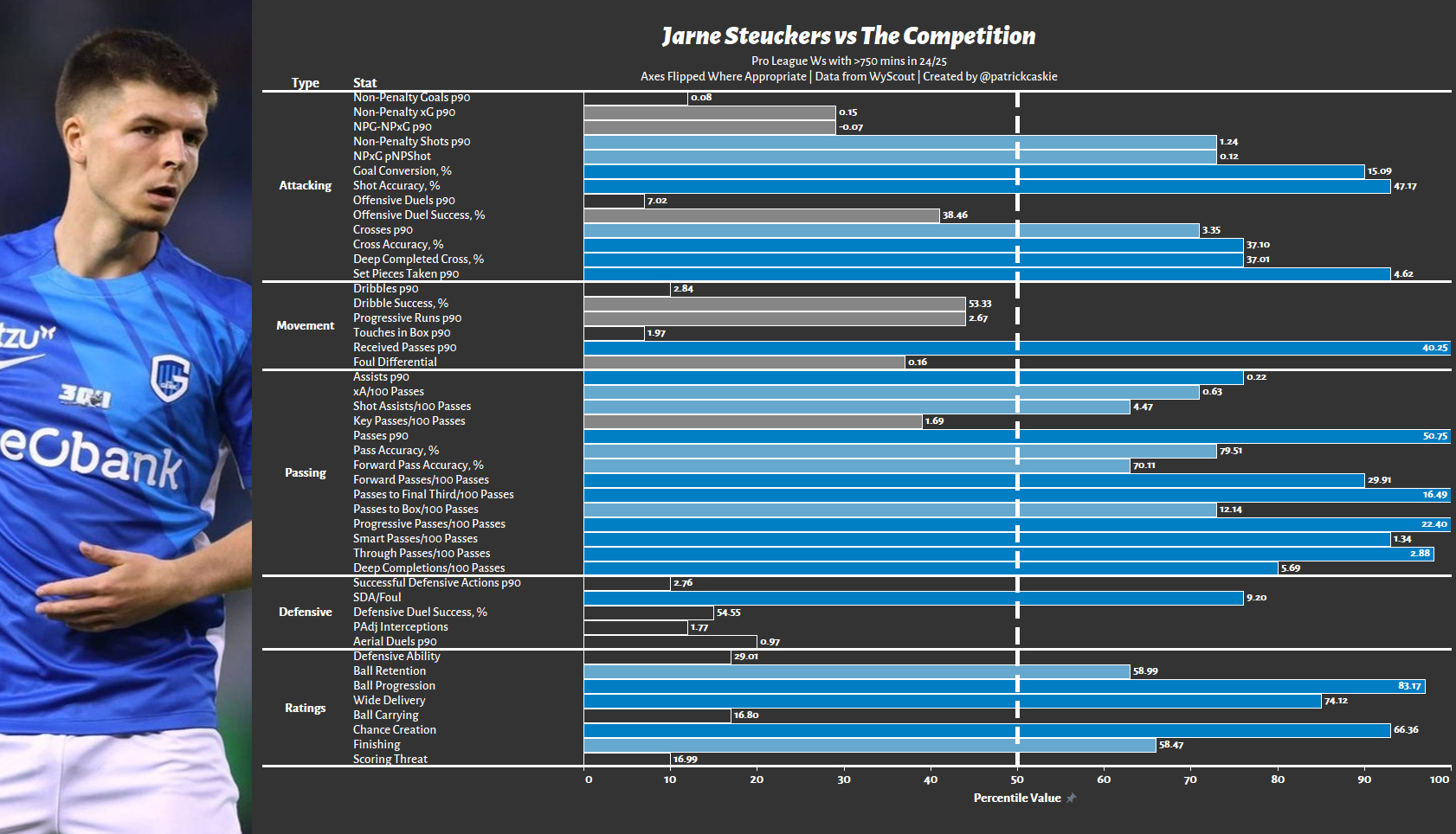
Bolstering the creative ranks is Junya Ito, who returns to Belgium after a successful stint in France, where he, amongst others, made an admirer out of Brigitte Macron, the nation’s first lady.
"I don't have any players in Reims, but I watch the team like all the other French and foreign clubs. What's happening here is very good ."
"There's a Japanese player who plays very well in Reims, what's his name again? Junya Ito?" Yes, Ito, that's it. He's very good. We have to select him for the team, Didier! Why don't you take him?
Well, because he's Japanese
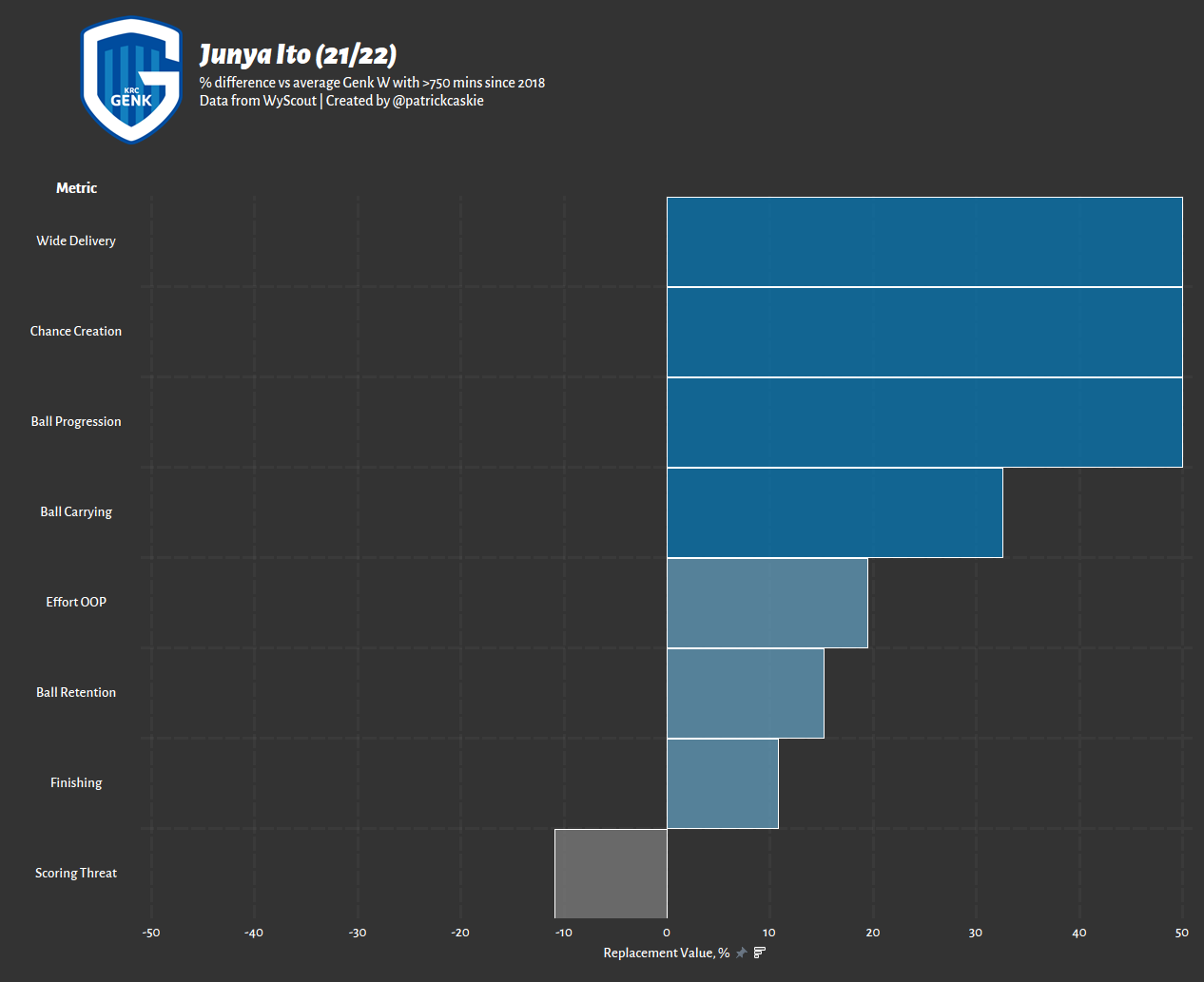
It's hard to underestimate just how good Ito was in his final season at Genk, 2021/22. The graphic below shows his KPI scores against a sample filled only with clubmates past and present, and it's fair to say he blows everyone out of the water; and this is a sample filled with talent: Lenadro Trossard and Mike Tresor are the standouts.
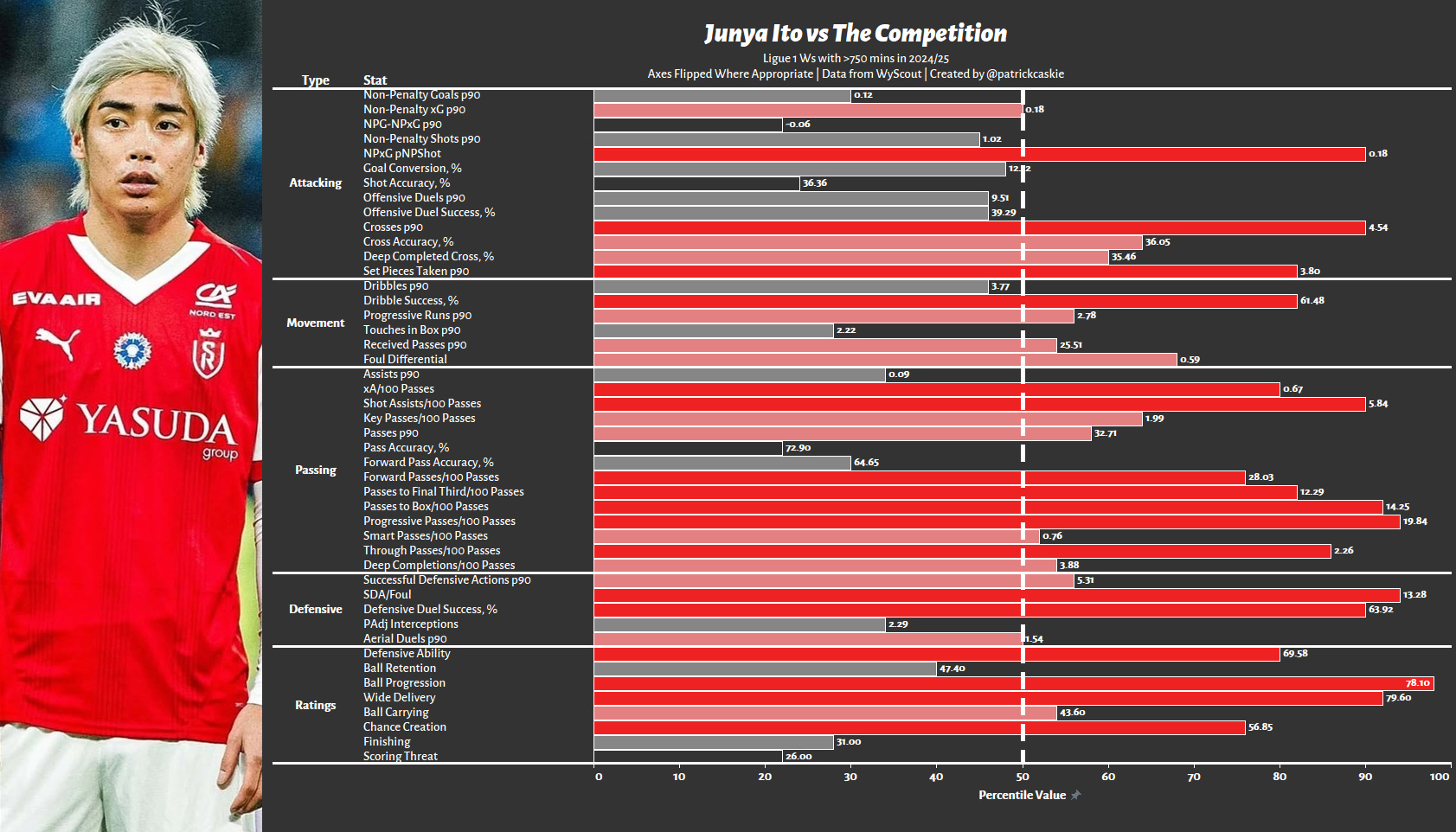
He did not slow down all that much in France either; his final season, the recently completed 24/25, was also outstanding, as evidenced in the percentiles below. As with Steuckers, Ito is also more of a creator than scorer, which may disrupt the balance of the frontline should they be played together; the no.9 will not complain.
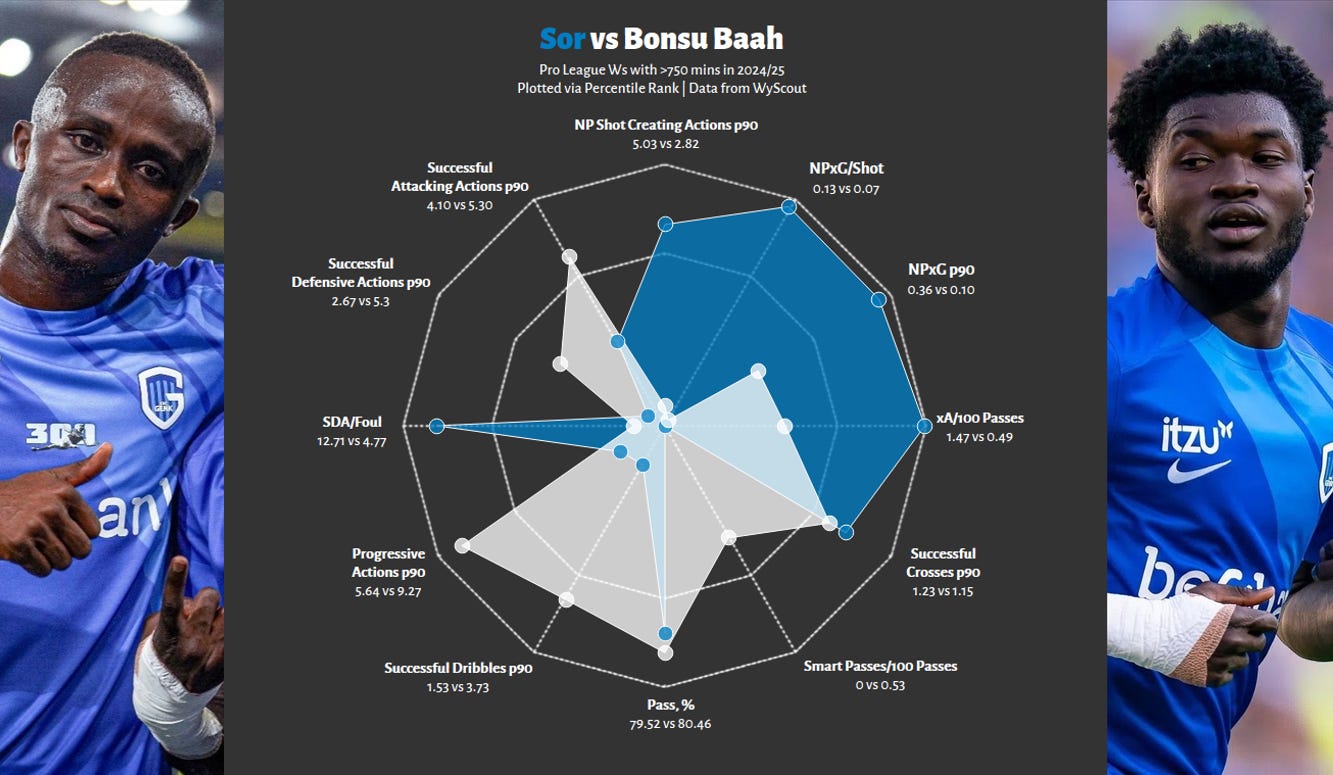
Alongside the primary creators, Genk has several score-first winger options who, albeit not as good as the duo already introduced, may be more effective given the requisite balance needed for a functioning front three/four. Former Slavia Prague forward Yira Sor is a demon against tired legs, operating much like a sixth man in basketball, and is relatively important to the side, even if his minutes are limited. He’s a pure compiler, taking shots where possible but also able to slide teammates in. If you leave him to his own devices, he will hurt you. Think of the sort of activity-to-efficiency ratio you would get with Fashion Sakala. Compared to the outgoing Bonsu Baah, he’s clearly a few years ahead in terms of end product. Still, he is nowhere near the dribbler the Ghanaian was and will never be. Sor has been sidelined recently but is reportedly back in complete training ahead of Thursday.
Alongside Karetsas, I think Adedeji-Sternberg is Genk’s most exciting prospect; he’s the purest all-rounder they have. He can score, can create, can attack in isolation or drop deep and to top it off, he is ambipedal. The distribution of the radar below speaks for itself.
Genk’s Head of Football is certainly reading from the same sheet.
“Noah has developed enormously in recent seasons, and we strongly believe he hasn't reached his ceiling yet. He combines technique with performance and fits perfectly with our football philosophy. It makes us proud that, despite international interest, he has decided to continue his career at KRC Genk.”
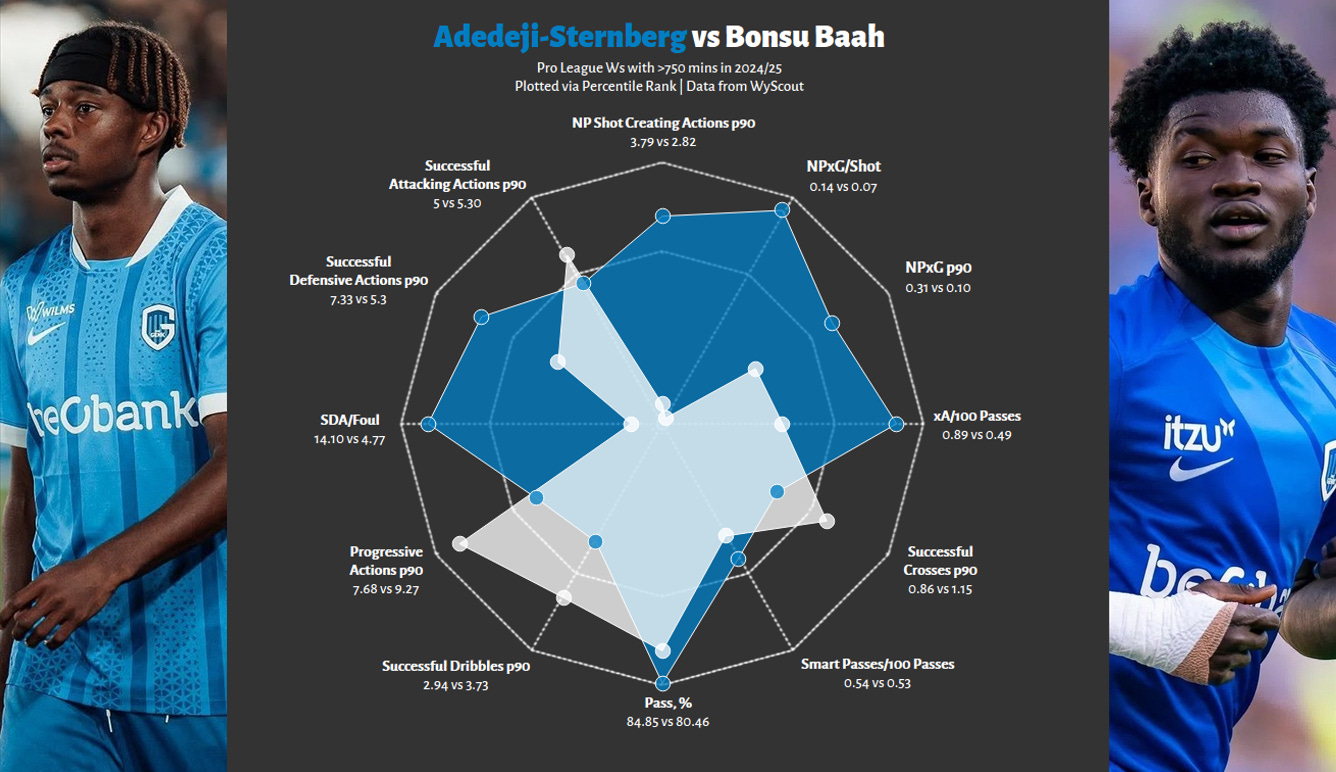
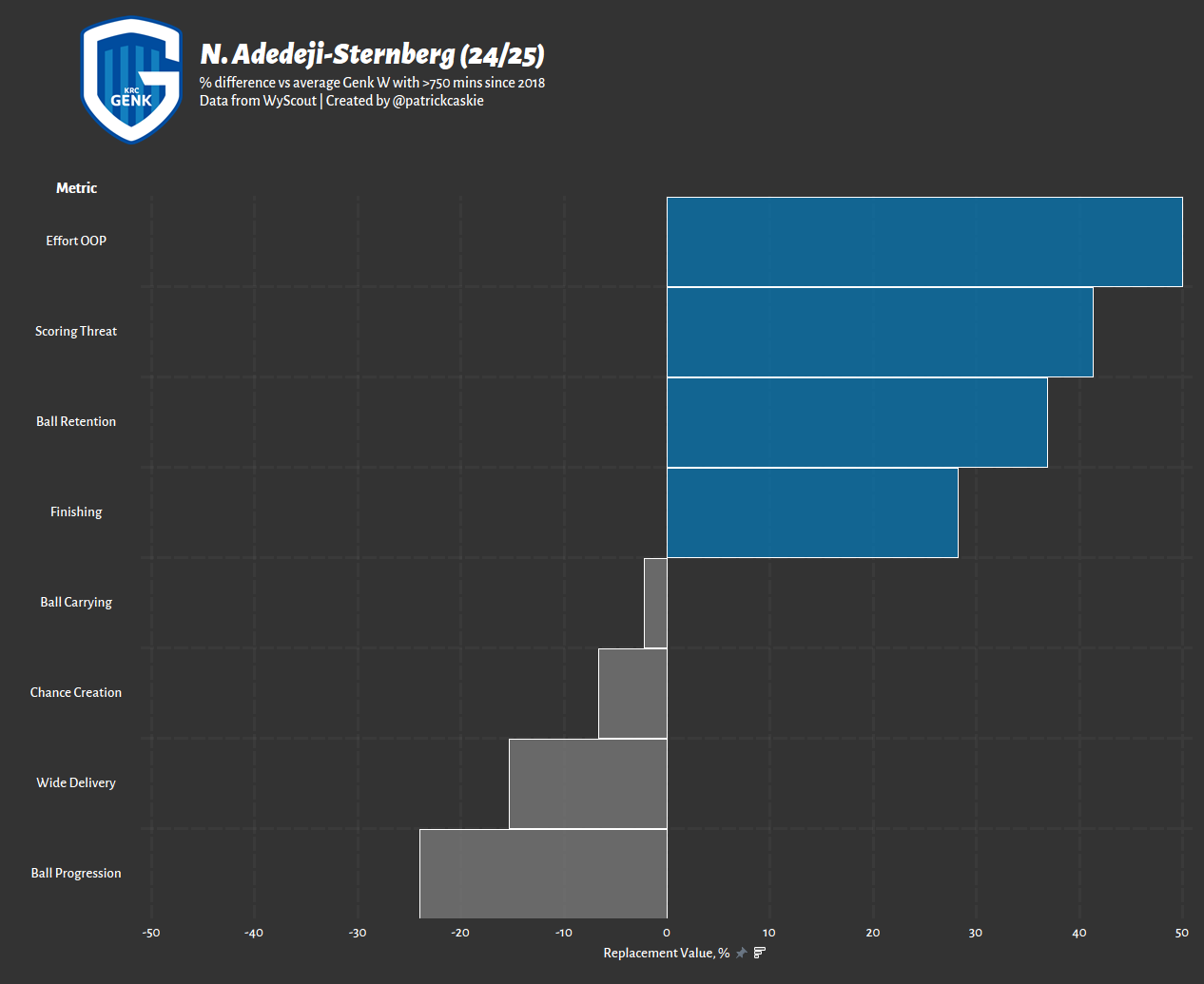
If the radar is not enough to convince you that the 20-year-old is the real deal, then below is his standing amongst Genk's peers. He excels at what he's good at, which are the skills that make money; goals, and even in areas where he lags, it's far from polemic. The hope, much like with Karetsas, is that age and experience disrupt talent; that hasnt really manifested in the past, though, think Rayan Cherki and Malick Fofana.
Genk signed a second Japanese winger this season, Ayumu Yokoyama from Birmingham City, for a fairly tasty €3m. He hasnt played much since arriving and did basically nothing in England to warrant the price tag, so I don’t expect him to kick off his career at Ibrox, but you never know.
Erabi, Oh and Co
Genk’s striker conveyor belt may be their best work. They bring in player x to replace high-scoring player y, and they almost always do it, whilst y’s new employers are left scrambling, trying to find whatever magic juice got their new boy scoring in Belgium and often failing; see Onuahcu and Samatta.
You could mistakenly interpret the Belgian side as a mid-2000s EPL side based on their penchant for big lads up front. The target man is a perennial feature of modern Genk identity, which is somewhat clarified by the placements in the ternary below. Tolu has left, and with him a large hole, although we’ve already established it’s likely not as cavernous as many think. What sits in his wake is a trio of CFs, each slightly different in their approach, see the ternary again, but all young and exciting.
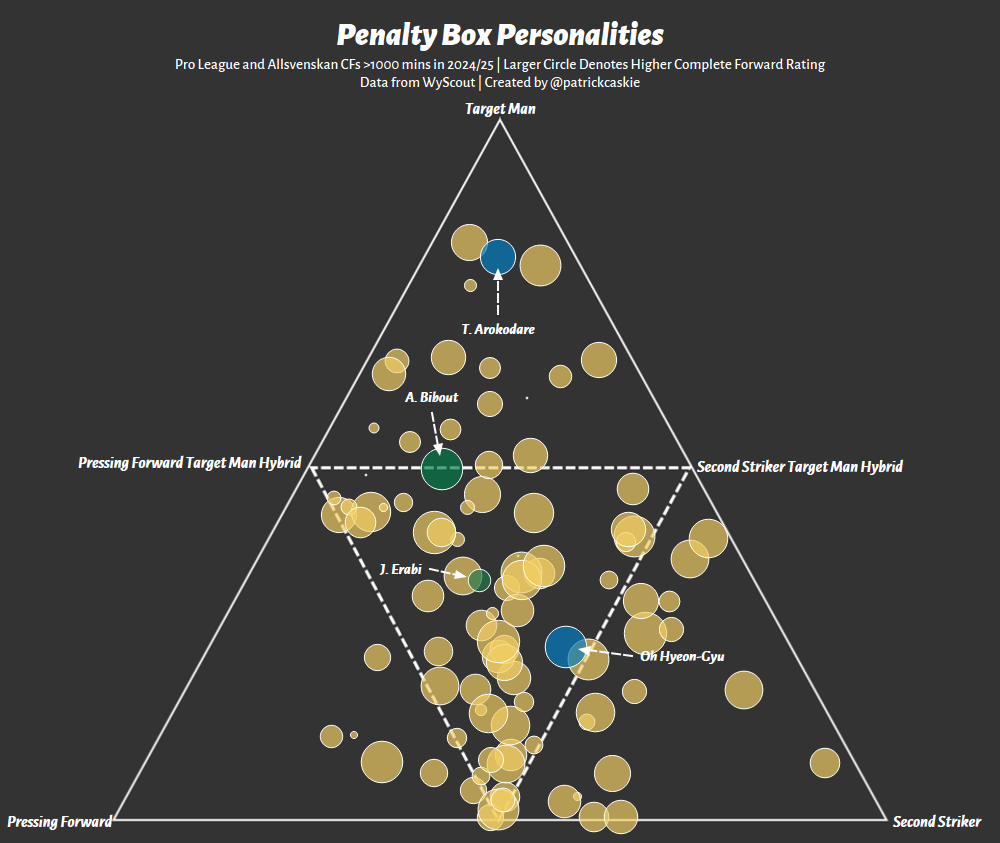
Many will have been taken aback when they first saw the tweet below, “just how much!?”. If you’re a Rangers fan, you probably chuckled a bit, thankful that the Korean, Hyeon-Gyu Oh, was wasted mainly at Celtic, but quickly snapped back into reality and realised the repercussions for a market that is that hot - transfers like our own Youssef Chermiti deal.
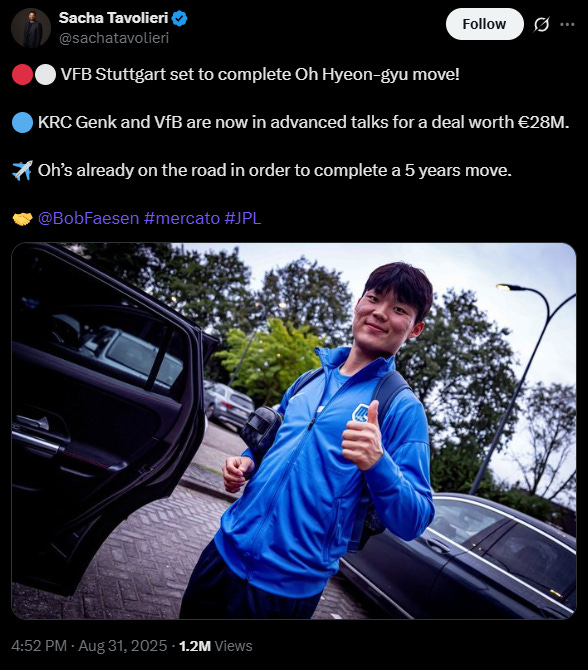
For Oh, a move to Genk to play under Fink was the golden ticket; the CF quickly identified the German as the catalyst for his country’s biggest stars’ rise and wanted in.
“I remember how coach Fink played Heungmin quite regularly, even though he was such a young player at the time. The fact that coach Fink had that kind of experience with a young Korean player in the past made a positive impression on me. Also, because I know his history with a legendary Korean player, I feel the responsibility to do well under him as well.”
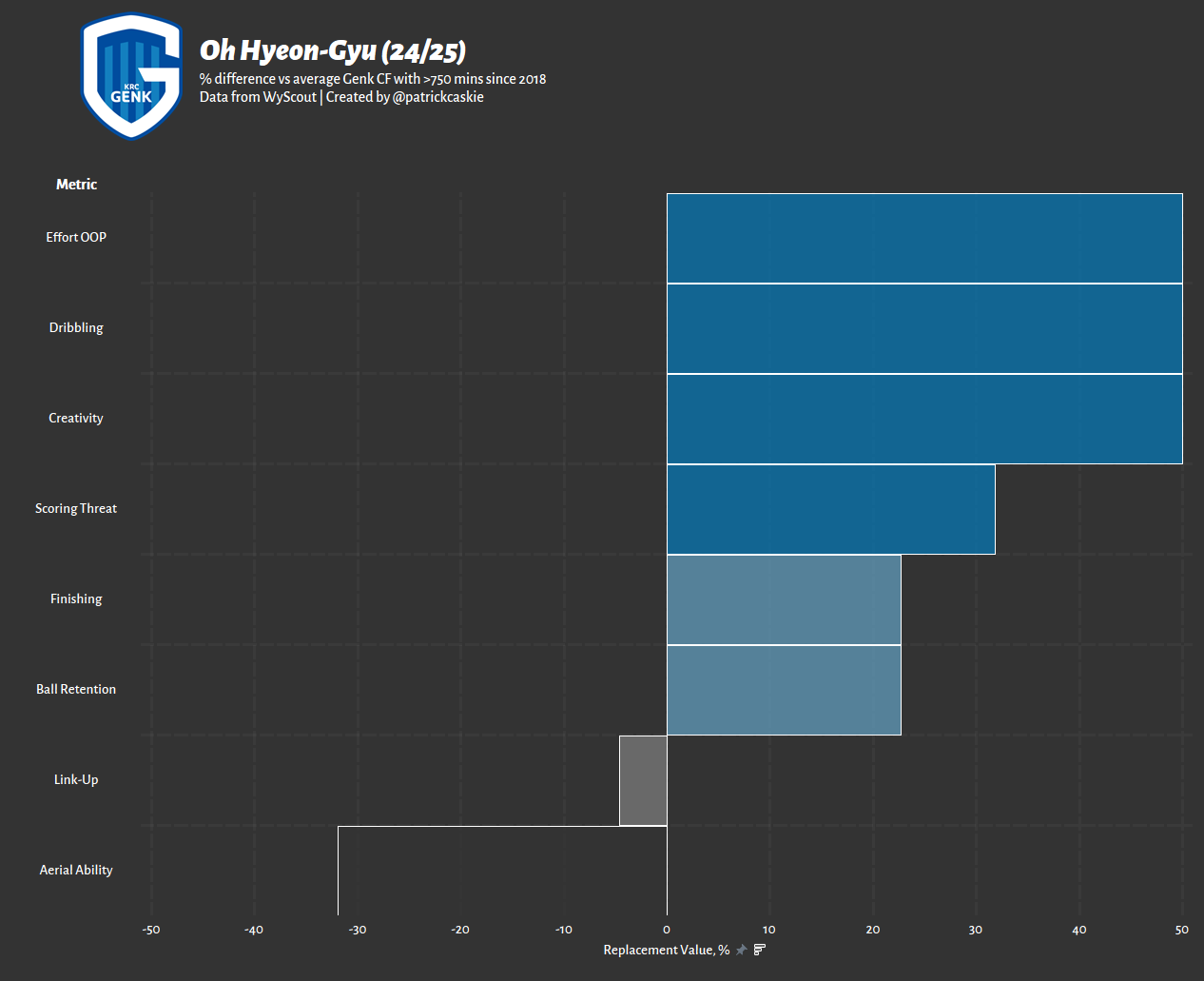
Although not quite on Son’s trajectory, Oh has made massive steps towards football’s elite whilst in Genk, doing so mainly as Arokodare’s backup, feasting on tired legs. His overall output is second to none, as evidenced below. He does basically everything you can ask, although his data is undoubtedly inflated due to game state and opponent fatigue.
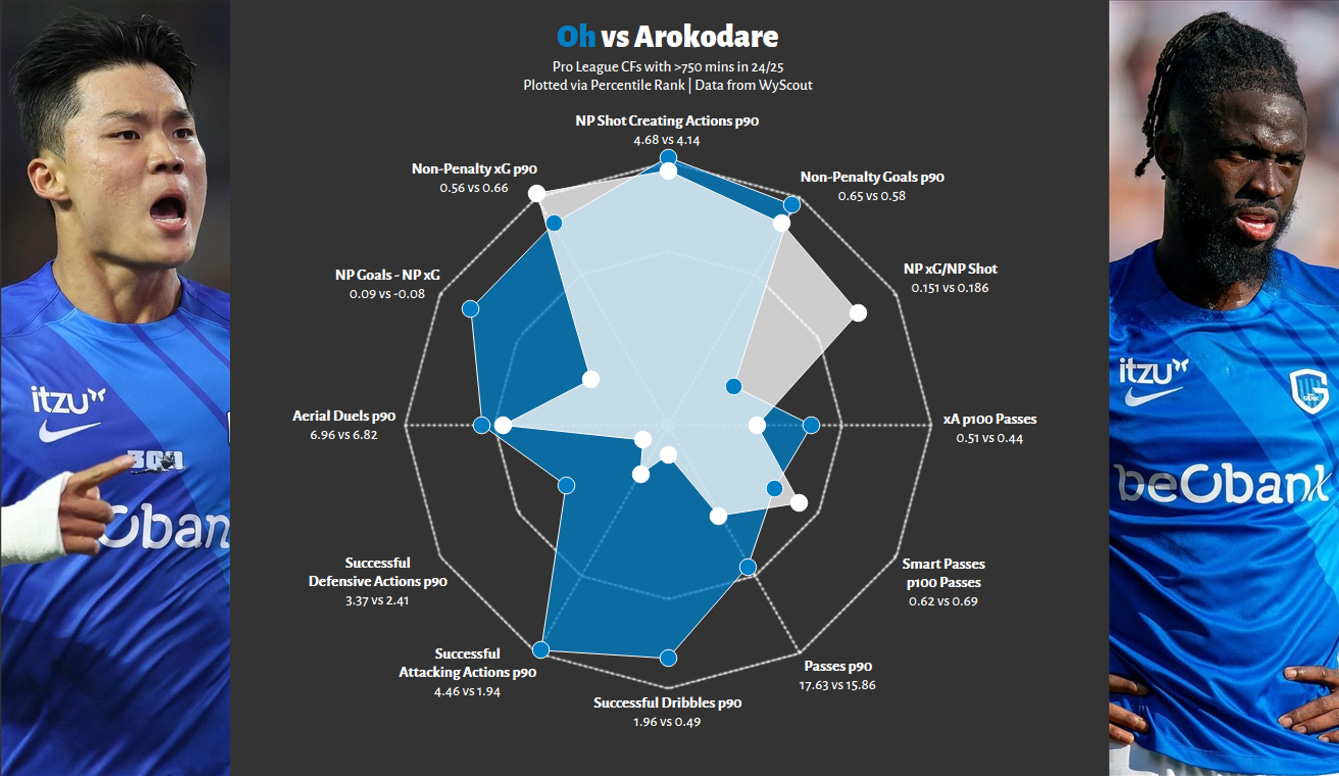
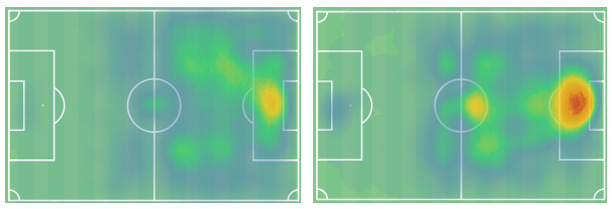
The distance between the players on the previous ternary communicated a clear message: these two are not the same type of striker. Tolu is more of a classical target-man, while Oh is an all-round accumulator. To confirm, consult the heatmaps below. Tolu is a pure penalty box player who will drop centrally in line with his side’s overall shape, whereas Oh loves to drift yet still constantly hunts penalty box touches.
Yeah, he looks good.
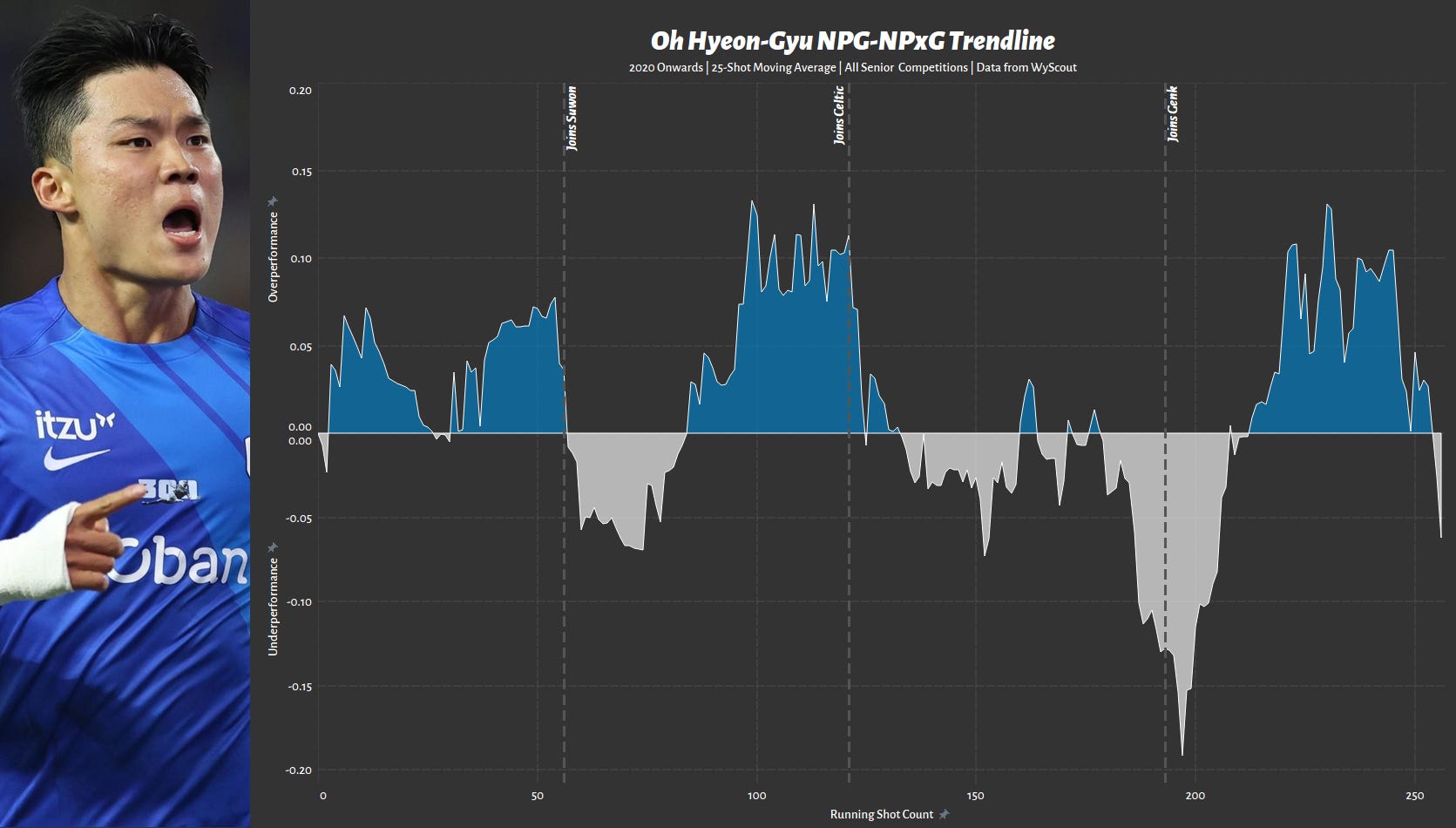
For the one or two aggrieved Celtic fans who may be reading and thinking this description couldn’t be further from what you saw from Oh at Parkhead, rest assured, there is reason; he was uncharacteristically bad in front of goal, for nearly his entire Celtic tenure, he underperformed his cardinal function, to finish chances. We may have caught him at a good time, as he’s currently also in the midst of some sharp underperformance.
In replacing Arokodare, Genk brought in two strikers based in Sweden, who play in green, best described as target men, although to varying degrees of purity.
First, the more notable but less pure, Jusef Erabi. The Swedish U21 international was signed for around €4m. Erabi reportedly stands at just 183cm, not the tallest for a target-adjacent forward. Yet, he makes up for it with a thick and muscular build, which allows him to dominate in the air and post up defenders with ease. The chart below doesn't paint him in the best light. Still, it does unequivocally promote his target-man chops, scoring goals, and patrolling the airways.
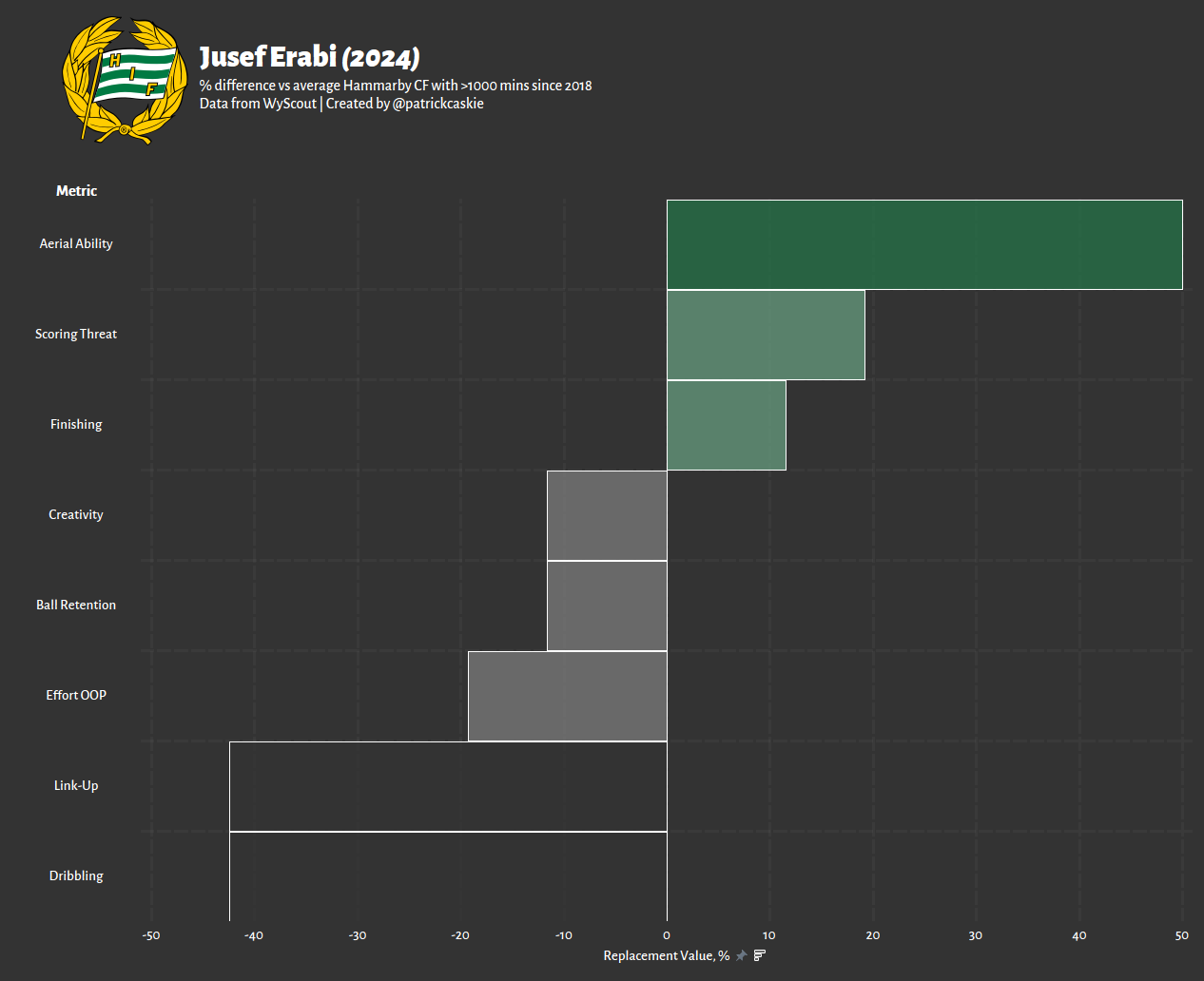
He is a better player than either graphic suggests, above or below. He’s a robust physical presence, has a good touch, can trap and control the ball consistently, and can score all types of goals: right-footed, left-footed, and headers. He’s far from the finished article, hence the relatively middling fee for his age, but would definitely have been someone I would have targeted for Rangers this summer. For what seems to be a similar price to Miovski, I think there is only one winner.
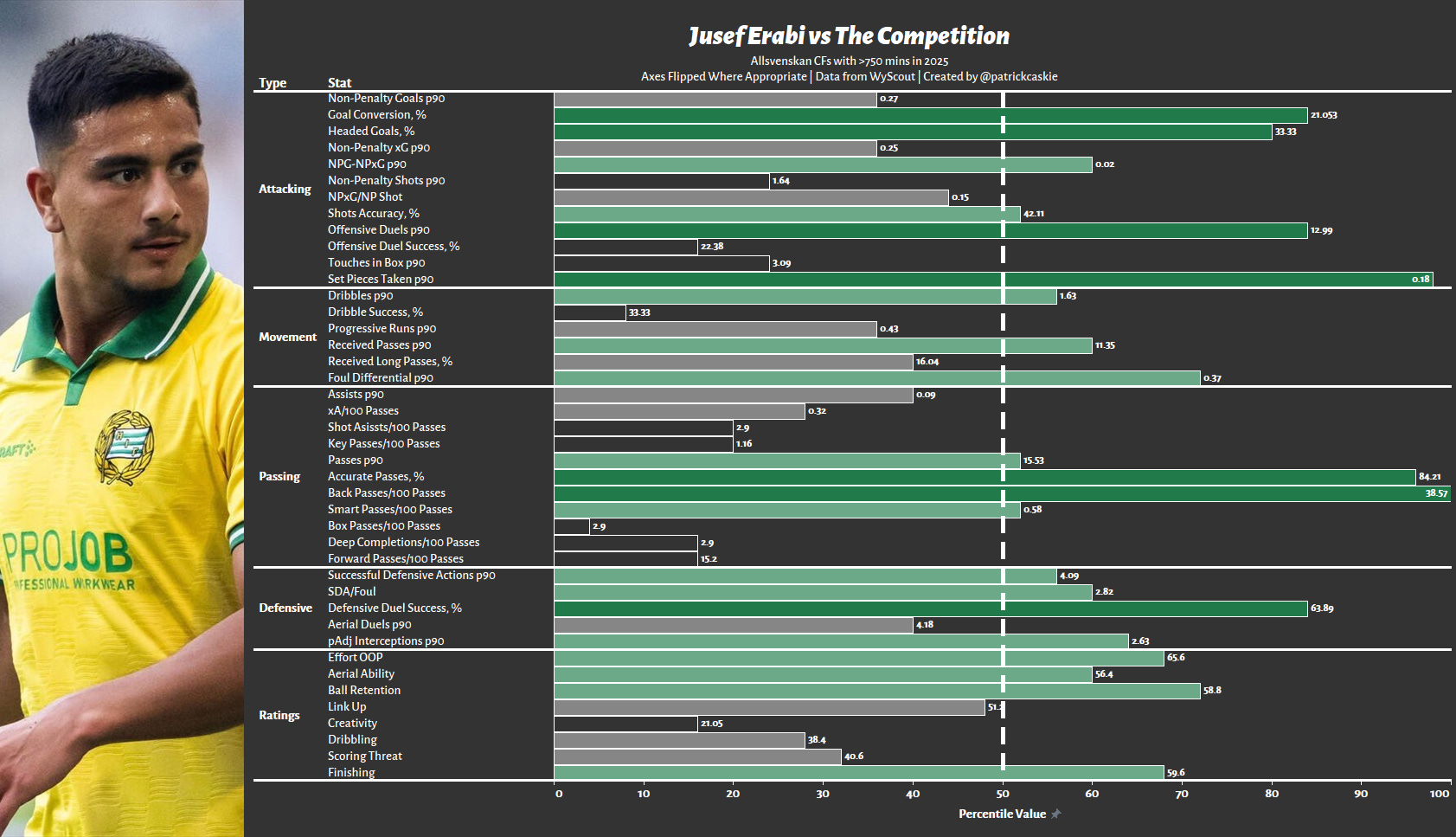
I wouldn’t be suprised to see Erabi at one point throughout the 90, with a starting berth a possibility.
I can’t say the same for summer arrival Aaron Bibout, who provides another data point for just how hot the CF market was this summer. Bibout, a former LA Galaxy II player of the year, played just 11 90s in the Supertettan, Sweden’s second division, before moving to Belgium for over €2m. He did very well during his time in Västerås, as supported by the percentiles below, but that price was for a 21-year-old with just six goals in Europe.
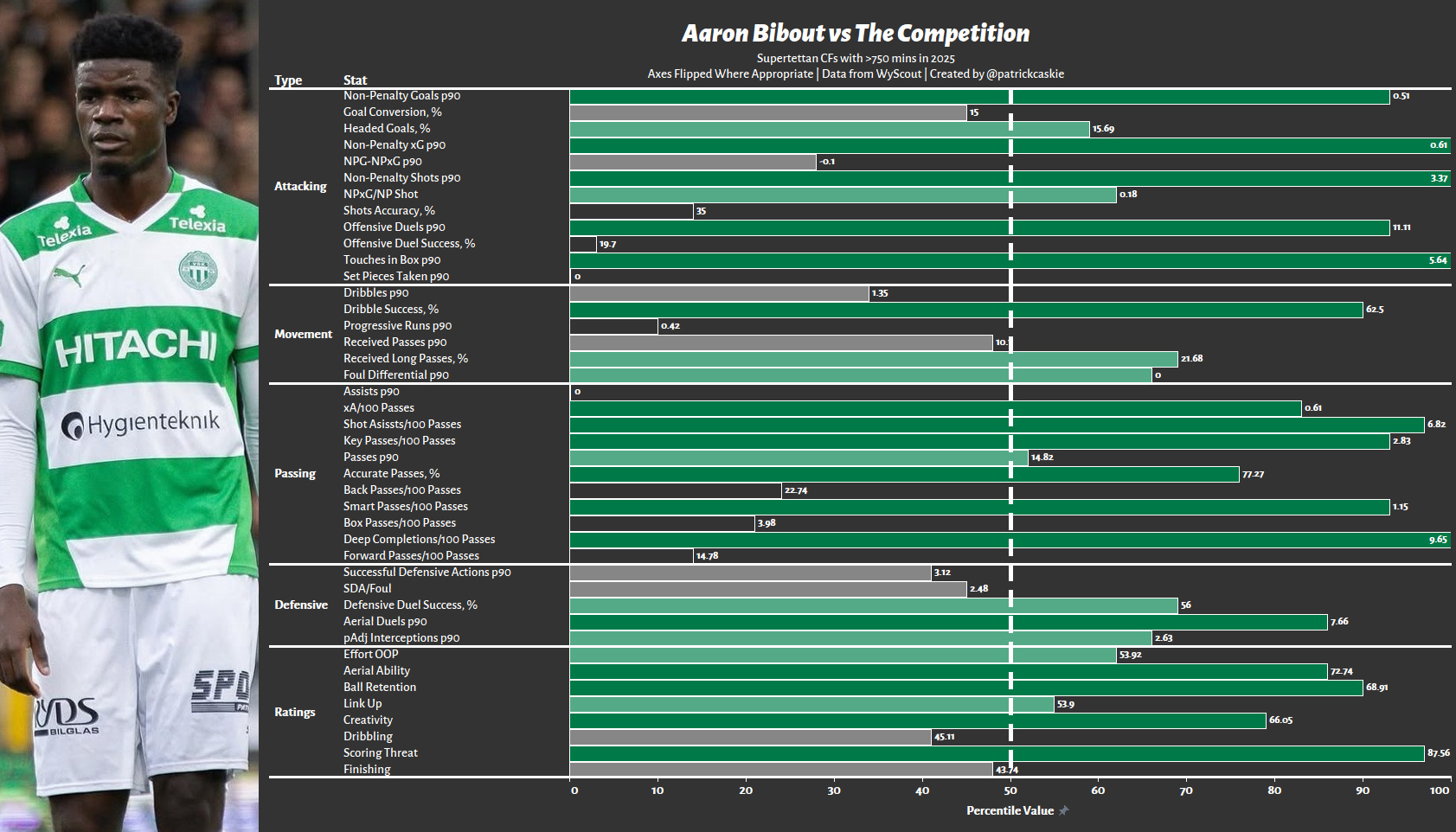
He looks like a fair punt in the current economy. Anyone with that sort of body who can move well and score goals at any level will have suitors, but it seems like a job for Jong Genk, the club’s B-team for the time being. Alongside Bibout at Jong Genk is Robin Mirisola, who recently broke his senior duck, scoring in a league game last month. Both seem reasonably solid prospects, but are equally players you would happily welcome to play minutes against us on Thursday.
Question(s)?
Heading into Thursday, there are the key questions vis-à-vis their starting XI.
Who partners Heynen in midfield?
Will Karetsas be fit to start?
Which wing-pairing will Fink choose?
Who will lead the line?
Conclusions
It’s relatively easy and quick to conclude.
Both teams are suffering in a bad patch. Genk has better players; we have home advantage. Bet365 is pricing the game with Rangers (2.45) and Genk (2.75), backing plenty of goals, which seems fair. However, we saw two similarly misfiring and underperforming teams joust at Ibrox weeks back, and it was terribly dull.
If Rangers are serious about repeating their feat of reaching the top 8 or being seeded for the first knockout round, then this is a must-win; if the goal is just knockout football, then a top 24 finish will suffice, and this tie is a must-not-lose.